Happy Sunday, beautiful cats! How are you today? I hope you’re having a lovely weekend! Yesterday we started feeling some very cold weather and was happy to take out my winter boots so that I could enjoy a fresh and crisp walk to work: the view was beautiful with the clear blue sky over the hills, the light colours over the hills. For lunch, I had homemade baked mac and cheese, but more importantly, I had some delicious cinnamon rolls for breakfast. You know that I like easy and quick recipes so you might be surprised that I am sharing this with you, but listen, this is a recipe for a 1-Hour Vegan Cinnamon Rolls recipe by VeganRicha. I made it while I was cooking dinner – how great is that! So here it is.
1/4 cup (59.15 ml) aquafaba chickpea brine, (or use room temp non-dairy yogurt or 1/4 cup coconut milk + 1.5 tbsp flax meal. Though the rolls do best with aquafaba)
1 tbsp sugar or other sweetener
1 tbsp maple syrup
1 packet active yeast or 2 1/2 tsp active yeast
2 tbsp oil or use melted vegan butter. I usually use oil
1 tsp nutritional yeast (optional)
2.5 cups (312.5 g) or more flour I use unbleached white or a combination of white and wheat flour
1/3 tsp (0.33 tsp) salt
Filling:
1 to 2 tbsp Oil or melted vegan butter
1/3 cup (53.33 g) or more coconut sugar or brown sugar
2 to 3 tsp cinnamon
1/4 tsp (0.25 tsp) salt
Add some cardamom or nutmeg for variation
Instructions
Preheat the oven to 350 degrees F / 180ºc. Line a 8 by 8 inch brownie pan or 9 inch pie pan with parchment. Mix the first 5 ingredients under rolls until the sugar is mixed in. Let sit for a minute for the yeast to activate.
Add in the oil, nutritional yeast and mix in. Add 2 cups flour and salt and knead. Add more flour, few tbsps at a time to make a soft somewhat smooth dough. 4 to 6 mins.
Roll the dough out using additional flour into a 10 by 14 inch rectangle
Spray or brush oil or vegan butter on the rolled out dough. (use as much melted vegan butter as you like :)).Sprinkle sugar, cinnamon and salt evenly. Roll the dough tightly along the longer edge to make a cylinder.
Slice using a pizza cutter or floss or a serrated knife. Place the slices in a parchment lined brownie baking pan or pie pan. Spray or brush oil on top. Cover lightly with a towel and Let the pan sit near the warm oven for 15 to 20 minutes or until just about doubled. Remove the towel.
Bake at 350f / 180ºc for 21 to 23 minutes or until golden on some edges.(just about starting to get golden)
Let the rolls sit for a few minutes, while you make the icing or frosting of choice. Frost and serve.
Hello kittens! I hope you’re having a nice weekend and managed to get at least 5 minutes to do something for yourself – we’re getting into one of the busiest times of the year, we just left Halloween and preparing for Christmas (and for the U.S. cats, Thanksgiving too!). Yesterday, my town had the first Christmas event of the season and it was so crowded! Plenty of lovely handmade stuff, though, from candles, soaps, and gin (!!!). Also, I had another Taek-Won-DO pre-grading, now going for a blue belt red tag! In addition to this, with my partner, we went to his brother’s birthday dinner: always lovely to see his family but at the end of the day I was happy to go to bed. And I won’t have a free Saturday until next year. I’m already tired.
2 tsp chili-garlic sauce (sambal oelek or Sriracha)
4 cloves garlic, grated
⅓ cup warm water
For the Noodles & Vegetables
250 g dry wheat noodles (Chinese-style lo mein), soba or ramen
3 cups green cabbage, chopped
3 cups sliced mixed mushrooms
1 small white onion, thinly sliced
1 bunch green onions, thinly sliced
Optional: 250 g tempeh or tofu, cut into small cubes
1 tbsp tamari
Garnishes
green onions, thinly sliced
sesame seeds
toasted nori, thinly cut
Instructions
Make the Miso Sauce: Add all sauce ingredients to a medium bowl. Stir until smooth. Set aside.
Cook the Noodles: Prepare noodles according to package directions. Once tender, drain and set aside.
Cook Tofu or Tempeh (Optional): If using tempeh or tofu, heat 1 tbsp oil in a large pan, over medium-high heat. When the pan is hot, add the tempeh or tofu cubes. Cook for 6-8 min, breaking apart into smaller pieces, until golden-brown. Remove the pan from the heat, then drizzle over 1 tbsp tamari. Toss to combine. Transfer to a plate and set aside.
Stir Fry the Veggies: Heat 2 tsp oil over medium-high heat. Add the mushrooms, cabbage and onions. Season with a pinch of salt and pepper. Cook for 4-6 min, stirring occasionally, until tender. Add green onions, reserving some for serving. Cook for another 2-3 min, stirring often, until tender-crisp.
Add Noodles & Sauce: To the pan, add drained noodles and miso sauce. Cook for 1-2 min, tossing gently, to coat noodles in sauce.
For Serving: Divide noodles between bowls. Top with tempeh (if using), green onions, sesame seeds and toasted nori. Drizzle more chili-garlic sauce over top, if desired.
Hi everybody, I hope you are well. In the past weeks, there has been a lot of tumult caused by recent events in the Middle East. After an attack by Hamas on Israel, which killed 1400 people, Israel has been continuously attacking Gaza and now the death toll for Palestinians is around 12,000.
With this, the world has been divided between anti-Palestinians and anti-Israelis. This is a complex situation, and inevitably there are sides to take. In the past days, I have tried to look into this difficult topic and I will show you what I have found.
Pro-Israel
The more mainstream media usually has pro-Israel views and U.S.A., U.K and Europe are supportive of the Israeli government. Media and Western governments mostly endorse Israel as they claim that that’s the only safe place for the Jewish people: historically, Jewish communities have been made unwelcome in all the countries they tried to settle and the land where Israel now Israel has the strongest religious and cultural connection with the Jewish people.
So, the State of Israel is a recent invention, it was created in 1947 thanks to the Balfour Declaration. With this, were also created the two regions of the Palestinian territories, the Gaza Strip and the West Bank, with Jerusalem being divided into East Jerusalem (as part of the Palestinian territories) and West Jerusalem (for Isreal). This was done without consideration of those who were already living in that area who were displaced in nearby countries.
While Israel was granted determined territories, it started expanding its territories by building illegal settlements and taking lands from the Palestinians. the claims that the Israeli government has a right to defend itself from Palestinian attacks.
Strategically, Israel is the only non-Arab nation in the Middle East so all the Western Countries like to have it there. Israel is also the recipient of millions of dollars worth of arms from the U.S. (read also here and here).
So it makes sense that Israel is where it is.
Pro-Palestine
Those who are more pro-Palestine, do so because for years, Israel has been attacking Palestinian houses and buildings with the excuse that terrorists live and hide in civilian places and illegally annexing Palestinian territories.
Despite Israel’s behaviour has always been condoned by Western countries, many people are calling out Israel as well as calling for a ceasefire.
It is not a matter of religion
The main issue in this conflict is that it is being passed as a religious war, between Jewish and Muslims, but it is actually political. Israel has been governed by Zionists, a nationalist movement that claims that the homeland for the Jewish people should be in Palestine. Zionists are not a religious group, but political. Their ideology has nothing to do with the Jewish religion.
They are a far-right group that seeks to get as much land from Palestinians as possible.
On the other hand, Palestinians did vote for Hamas: this party came to power in 2006 with the vision for a two-state solution and to accept the 1967 borders with Israel. However, this position has changed since Hamas came to power with more extremist heads of Hamas saying that as Israel wants to eliminate Islam, all Muslims should destroy Israel.
This means that what Palestinians voted for in 2006 is not what is now in power.
There is also the issue of the disproportionate response by Israel, one of the most powerful armies, against what essentially are the Palestinian paramilitary forces.
And as said above, Israel continues to receive military and financial support by most of the Western countries.
How Can You Help Palestine – Avoid These Companies
It feels so frustrating and powerless when these events are unfolding. When it is clear that human nature and greed are the cause of all this suffering. You might think that you cannot do anything to help, apart from sending money to the relevant charities operating in the affected places. But there is something else that you can do – hit them where it hurts – don’t give money to those supporting this mass murder.
I wasn’t surprised to find out that some of the big multinationals that are most cruel towards animals and less respectful of workers and the environment are also those supporting the Israeli government. In this post, you will find an image of the main food companies and the ones they own.
Following are articles or pages showing the connections of these companies with Israel, or having a presence in the illegal Israeli settlements:
On top of this, there are other companies on boycotting lists (such as here, here, and here).
It might not be surprising that these companies are also the same ones connected to Monsanto and that this one is famous for the creation of Roundup pesticide (you can read more on this here, here, and here).
This is a very difficult situation, saddening and frustrating. With all respect to all the lives involved, what has been presented above, are just facts. In 1947, the British created the State of Israel and two regions for the Palestinians. Since then, Israel has kept attacking these territories to then build Israeli settlements in Palestinian lands. The most recent response of Israel to the 7th October Hamas attack (where 1400 have been killed), has been to use missiles, rockets, etc. on hospitals, schools and civilian buildings (having killed indiscriminately military and civilians for an ever-increasing death toll of 12,000).
This is not a measured response – this is a genocide. And little is done to condemn the actions of a bully.
You have plenty of resources that you can check, but these are the facts.
Hey, cats! How are you these days? Here it’s been a good week – I was working yesterday but I went to deliver a course in one of the nearby libraries and it’s always a pleasure going there, the drive there is very scenic and yesterday could have not been a better day to go as it was a cold, clear-skyed day, with all the autumnal colours around! Really a beautiful view that made my day, one of those views that recharge the spirit. When I came back I felt energised and managed to do quite a lot of things – feeling very positive. And these Almond Flour Cookies by ElaVegan were just what I needed for this lovely day!
First, preheat the oven to 350°F (175°C) and line a cookie sheet with parchment paper.
Then, mix the almond flour, baking powder, and sugar in a medium bowl (or a food processor) until there are no lumps.
Add the almond butter (or nut/seed butter of your choice) and mix well. If the dough is dry, which it likely will be, add a tablespoon of water and mix again.If it’s still too dry, add more water, a teaspoon at a time, mixing thoroughly in between.
Fold in the chocolate chips, reserving a few for the top, then use a small ice cream or cookie scoop or tablespoon to divide the dough into 6 cookies.
Spread the cookies across the prepared baking sheet with space in between, using your fingers to flatten them gently, and press the reserved chocolate chips into the top.
Bake the cookies for 11-12 minutes until they’re lightly browning on the edges. They will be soft right out of the oven, but firm up as they cool. Leave them to cool on a wire rack. Enjoy!
Hello kittens! How are you? It’s finally getting colder and it makes me so happy! It’s time for cozy clothes and comforting food and after the madly hot summer, Autumn couldn’t come any quicker! And while I was enjoying the mindless scrolling on Instagram of a weekday night, I found this account of a vegan macrobiotic person and she was suggesting that in order to prepare our bodies for the colder months, it would be good to do a “detox” for a week following a macrobiotic diet. Since it was ages I wanted to go back to my macrobiotic practice, I thought this would have been a good time to do that. I signed up for the detox, and decided to extend it to the whole month.
Years ago, in 2012) I attended a course on Macrobiotics and I really enjoyed it. I didn’t quite agree with the teacher of said course as he said that it’s difficult to be a vegan Macrobiotic: bizarre because Macrobiotic is very much a pescatarian diet that can easily be turned into vegan. The course itself had a nice structure with a theory part followed by a dinner and lo and behold, all the dinners had only vegan dishes! I liked the theory part, very holistic and made you understand the interconnection of how what we do and what we eat has a significant impact on our lives. After the course was finished, I tried to maintain some of the Macrobiotics principles, but I slowly lost touch with it. The occasion of this detox was the perfect chance to go back and refresh my practice.
Why have I done this? I thought “I can do the Limpia for 50 days, meaning not being able to eat chickpea flour, so I can do this”. Mmmh, well. It’s not that easy. True, I can make vegan omelets but I can’t have potatoes! Oh goodness.
This is difficult. And I’ve fallen into the temptation of chips, once a week – potatoes are a big no-no in macrobiotic! But before I talk about this experience, I’ll explain what a macrobiotic diet entails.
Principles of Macrobiotics
Macrobiotic is a philosophy that takes a lot from the principles of yin and yang. The world and everything in it need balance in order to function properly. When there is a good balance between yin and yang in an organism, then it will have a good energy. For example, people should also have a balance, but many times they might have an imbalance and be too yin or too yang. Then there are also the dichotomy of acid and alkaline and the 5 elements (Earth, Fire, Water, Metal and Wood) – if you want to learn more about all this, the Macrobiotic.org.uk website has a clear and short page on the Principles of Macrobiotic.
The very positive thing about Macrobiotics, is that it’s basically intrinsically pescatarian so it’s very easy to make it into a vegan diet.
A Lifestyle, not just a Diet
You can see that Macrobiotics is much more than a diet – it is a lifestyle. It seeks to create a balance in your life and in your body by thinking of what is your body type (are you more yin, or more yang?), and then by thinking of the characteristics of what we ingest and how we cook this food.
We should open at least one of the three main meals (breakfast, lunch, dinner) with a miso soup so to prepare our digestive system to receive the food. It shouldn’t surprise that there is also a lot of mindfulness involved in Macrobiotics because we should eat without distractions and very importantly we should chew each bite for a long time – possibly more than 20 times, until the food is smooth and the digestive system won’t have to work for too long, in doing so to make digestion easier. One “experiment” or “exercise” when starting Macrobiotics is to chew a spoonful of plain boiled/steamed whole rice for 100 times!
Main Foods for a Macrobiotic Diet
When preparing a Macrobiotic dish, another big rule is to compose the food as 1/3 cereal, 1/3 protein, and 1/3 veggies. For example, at dinner, you could eat wholegrain rice, sauteed tofu and onion, celery, carrot.
So, what can you eat?
All the wholegrains: rice, millet, pasta too if wholegrain; All veggies; All legumes (especially adzuki beans and chickpeas); Seasonal fruit; Fermented dressings (i.e.miso); Seaweed; Brine food (Olives, sauerkraut); Gomasio; Ginger and turmeric.
What can’t you eat?
White flours; Nightshades (potatoes, peppers, tomatoes, eggplant); Refined oils; Meat; Cheese; Dairy products; Tropical fruits and vegetables (bananas, avocados, mangos etc.) Coffee, tea and alcohol; Refined sugar.
In moderation
Olive and sesame oil; Tofu and Tempeh; Good quality bread like sourdough; Raw fruit; Wholegrain pasta, cous cous and bulghur; Cereal malts; Nuts.
Methods of cooking
There is some theory also on how to cook stuff. In order to maintain or alleviate the yin/yang characteristics of the foods, the best way to cook is by steaming or lightly sauteeing. Baking is another acceptable cooking method.
When preparing any combination dish using more than one ingredient (i.e. soup), we should start with the ingredients that are closer to the soil and going up: for example, the order in which we would make a soup would be to start with onions and carrots (closer to earth) then celery, cabbage, broccoli etc (above earth).
What Have I Been Eating?
Breakfast
Porridge with apples and raisins
Rice pudding with seasonal fruit and raisins
Baked oats with apples and raisins
Lunch
Wholegrain rice with veggies and hummous;
Pumpkin soup with cereals + sauteed tofu and veggies
Millet with spiced chickpeas and steamed veggies
Dinner
Broccoli soup + sour and sweet tempeh and baked onions
Miso soup + scrambled tofu and steamed veggies
Chickpeas and broccoli soup
These are just some examples of what I have been eating: there are many different things that you can do!
My Findings
The “Not so good”
I have tried to follow this detox as best as I could, although I found some difficulties: it was really difficult to let go of coffee especially because I had 3 big events just after the start of the detox and I needed all my mental faculties to organise stuff at work. The potatoes (or more correctly, the lack of) were another issue for me – as I said, I fell into the temptation of chips once a week. I love potatoes, in every form and I use them to make cozy soups as well as roasted or mashed, etc. So that was difficult, but except for the Friday chips I haven’t used any.
The “Very Good”
Despite these little setbacks, I quite enjoyed the simplicity of the dishes and I liked to think more about what I was going to make, how it was going to affect me, was I making something too yin or too yang? Did I do a lot of exercise and so I was too yang? Was it cooler or warmer outside? And so on.
The past weeks I have also used a lot of apples, a fruit of which I am not too fond, but using them in porridge and rice dishes made me appreciate them more.
Energy-wise I wasn’t totally 100%, but again I had a lot on my plate at work, so that surely impacted how I felt.
Conclusion
While I wouldn’t follow a Macrobiotic lifestyle full-time, would definitely recommend this detox. The Macrobiotic lifestyle is something that adheres to principles of balance and mindfulness, something that most of us need to lead a healthy life. Similarly to the Limpia, you can try it for a short period and see how you feel.
Let me know what you think or if you would like to see other Macrobiotic recipes!
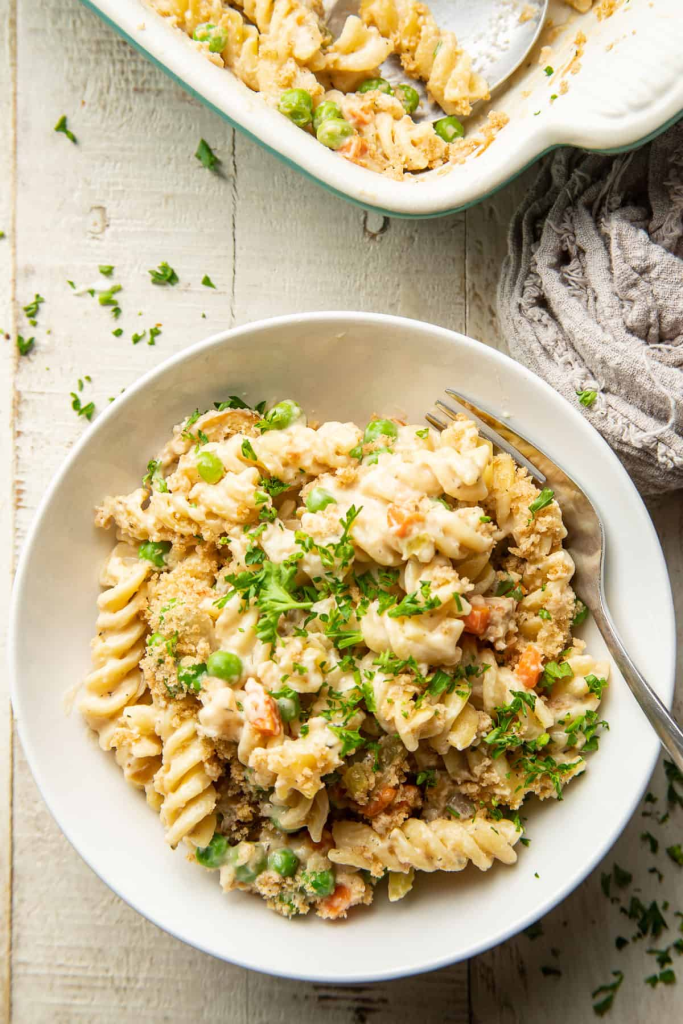
Hi beautiful cats! How are you? Are you enjoying your weekend? Last week, I finished the macrobiotic detox, but I keep making miso soup and drinking kukicha tea just to keep me right. However, I am also reintroducing the food that I couldn’t eat during the detox, i.e. pasta. And this Creamy Vegan Noodle Casserole by ConnoiserusVeg is exactly what I needed! Easy and delicious with minimum effort – perfect for a weekday lunch.
10 ounces dried rotini pasta (about 3 ½ cups of pasta)
½ cup raw cashews, soaked in water 4 to 8 hours, drained and rinsed
1 cup water
3 tablespoons vegan butter, divided
8 ounces button mushrooms, cleaned and sliced
1 medium onion, diced
2 medium celery stalks, diced
2 medium carrots, diced
2 garlic cloves, minced
3 tablespoons all-purpose flour
2 cups unflavored and unsweetened non-dairy milk
3 vegetable bouillon cubes, crushed
1 teaspoon dried thyme
1 tablespoon lemon juice
½ cup frozen peas, thawed
Salt and pepper, to taste
½ cup panko breadcrumbs
Method
Bring a large pot of salted water to a boil. Add the pasta and cook it according to the package directions. Drain the pasta into a colander when done.
Place the cashews and water into a blender and blend until smooth. Set aside.
Coat the bottom of a large skillet with two tablespoons of the vegan butter and place it over medium heat.
When the butter has melted, add the mushroom slices in a relatively even layer.
Cook the mushrooms for about 5 minutes on each side, until golden brown. Remove them from the skillet and transfer them to a plate when done.
Add the remaining tablespoon of butter to the skillet. Once the butter melts, add the onion, celery, and carrots.
Cook the veggies for about 5 minutes, stirring frequently, until they begin to soften.
Add the garlic and flour. Stir the mixture well to coat the vegetables with flour and continue cooking the mixture for about 1 minute.
Slowly begin adding the non-dairy milk, stirring in just a bit at a time to prevent the flour from clumping. Once all of the milk has been added, stir in the cashew mixture, bouillon, thyme, and cooked mushrooms.
Raise the heat and bring the mixture to a low boil. Lower the heat and let it simmer for about 10 minutes, stirring frequently, until thickened slightly. Preheat the oven to 350°F while the sauce simmers.
Remove the skillet from heat and stir in the lemon juice.
Combine the cooked pasta, sauce mixture and peas in a 2-quart casserole dish.
Season the mixture with salt and pepper to taste.
Cover the casserole dish and place it into the oven. Bake the casserole for about 20 minutes, until heated throughout.
Remove the foil from the dish and sprinkle the casserole with panko breadcrumbs. Bake 5 minutes more.
Let the casserole sit out for 5 minutes before serving.


 The Vegan Cat Librarian