9 Books That I Have Loved This Year (2024 edition)

Hello beautiful cats! We are at the end of 2024 and what a year it has been! It’s been another busy year, and finding time to read has not always been easy, but I have tried to dedicate at least one hour of reading before bedtime. There were nights I succeeded and other times I didn’t quite make it and in these cases, I would open the book, find the page I was reading and promptly fall asleep, and I kid you not, once I even dozed off while still holding my place with my finger, or so my partner told me!

You know that I love reading. It’s one of my favourite things to do (otherwise, I wouldn’t work in a library!), and I strongly believe it improves mental health. It also has (more or less) obvious benefits, like better literacy and vocabulary and opening the mind to other perspectives. Similarly to last year, I thought I would share my favourite reads of 2024: I managed to read/listen to 39 books and not all of them were a “win”, but the ones that I enjoyed are definitely more than those that weren’t really my taste, so it has been difficult to make a selection. But here there are the 9 best (according to me) reads of 2024!

The Fraud by Zadie Smith

This was the very first book of 2024 and it was in eAudiobook format through the BorrowBox app. It was also my very first book by Zadie Smith, and what a treat this was! It was a great introduction to her writing and the eAudiobook I listened to was read by Zadie Smith herself.

This is a historical book, with the “Tichborne Trial” in the background and the two main characters being a woman and a former slave, it shows how the British Empire was built on the labour of slaves, the misappropriation of lands in far-away places (i.e. Jamaica) and how this has never been really acknowledged to this day. You can see how some people might find this book uncomfortable, but I thoroughly enjoyed it.

A Woman Is No Man by Etaf Rum

This book found itself in my hands one day while I was covering the main desk at work, and from the title I was expecting something different. After reading the plot, I HAD to borrow it.

It’s a book that touches on the experience of a second-generation Palestinian-American, so you understand why I wanted to read it. And it didn’t disappoint! It provides a glance into the world of a family that emigrated from Palestine to America in the 1970s, the culture clash between Arab Muslims and Americans, touching also on the Nakba. It is highly recommended.

Why Has Nobody Told Me This Before? Julie Smith

Another eAudiobook, this time on Spotify.

A beautiful book of advice on how to live with more confidence and compassion (both towards others and yourself). Enjoying it as an audiobook felt like having a personal therapist offering valuable life lessons. While it’s not a replacement for professional therapy, it serves as a great resource for understanding your thought processes and discovering ways to enhance your well-being.

It also clarified which aspects I could tackle independently and where I might benefit from a therapist’s support. Get ready to put in some effort!

A Thousand Golden Cities: 2,500 Years of Writing from Afghanistan and its People by Justin Marozzi

This was truly eye-opening on a Country that is so full of history and yet has been relegated as being full of uncivilised people. Got it as an ebook on BorrowBox, and I’ll be honest it took me almost 2 months to finish because it’s around 1000 pages and full of excerpts from different books and sources: some I found were easier to read than others. There were many descriptions of the geography and the people by different authors in different times, from 200 BCE to 2000 CE, extracts (briefly) an ally to the West.

This book shows how, because of its peculiar location, Afghanistan has been used and abused by other empires.

It’s absolutely recommended.

The Seven Moons of Maali Almeida by Shehan Karunatilaka

This was just “Wow”. Another eAudiobook on the BorrowBox app. A kind of fantasy, but set in the very real Sri Lanka in the 1990s and its civil war, this is also a mystery book. A story of queer people, colonialism and corruption, it’s funny and sour. The idea of the seven moons as the time in the afterlife to make peace with oneself is so interesting, and the main character in the book uses this time to find who killed him.

It was easily one of my favourite books this year.

The Order of the Day by Éric Vuillard

I would have never chosen this book as it covers a time in history with which I can’t cope (WWII). It’s thanks to a friend that I read this book – I’m so lucky to have the friends I have!

While the book is promoted as being about various meetings of heads of state in the 1930s, I would argue that this is also a book clearly demonstrating how few families and companies own maybe not everything, but definitely a very good chunk of the economy. And they have always played major roles in politics too, by influencing events that at the time looked insignificant, but actually revealed themselves to be very important later.

It’s a short and (bitter)sweet book that should be read by everybody.

Paper Cup by Karen Campbell

A colleague suggested this book, she ordered it from another library for me and it took ages to arrive as that library was set to close soon and a lot of the stock was in boxed destined to other libraries, so I forgot about it and I didn’t have any idea of what the book was about until it arrived.

And it was absolutely brilliant! The main theme is homelessness, and this was another eye-opener. It’s set in Scotland in 2010s, the main character is a woman, and the book deals with her experience living in the streets for half of her life, but also an unexpected pilgrimage.

It’s a really sweet book, easy to read because of the beautiful writing but still heavy for the very real theme of homelessness.

I Haven’t Been Entirely Honest with You by Miranda Hart

This is the book I didn’t know I needed until I read it. Aside from the series “Miranda” (which I loved) by Miranda Hart herself, I didn’t really know her and her books. So I was happy to listen to the eAudiobook, read by Miranda, on Spotify. I couldn’t stop listening to it!

In this book, she shares her journey with chronic illness, detailing her struggles with being misdiagnosed multiple times and the reluctance of general practitioners to take patients—especially women—seriously when they seek answers about their symptoms. It’s such a close theme to me, that I felt so seen and understood (as I have been misdiagnosed twice, not been taken seriously after having been in and out of the GP practice for 4 years and now having been diagnosed with fibromyalgia) that I cried a few times while listening to it.

But it’s still Miranda Hart, and you will also get many laughs out of it!

Tyger by S.F. Said

Another eAudiobook on BorrowBox, again dealing with themes like racism and colonialism (is there a pattern? she asked rhetorically). It’s a fantasy book for young adults set in a similar world to ours, but with the British Empire still going strong, talking magical animals and a war of supernatural powers, where the themes of colonialism and racism are dealt with in such a sweet and delicate way, while at the same time almost presenting the reader with a call to action for the new generations (and possibly the older ones, too).

I’m a sucker for cats and here there is the gentle, big talking Tyger you can find in a YA book. It was so easy to listen to, I finished it in just a few days and who knows if there might be a sequel?

Conclusion

Looking at the list of books read this year, it didn’t really feel like I read a lot, but 39 books is not too bad. I am also aware that not everybody has the same time to read, the same attention span, etc, some people can read 5 books and some can read 150, we are all different and the main thing is to read whenever possible.

A couple of books didn’t make “the cut”: had to make a selection to bring you what I thought were the best reads for me, but I’ll leave you with the titles in case you want to check them out:

  • The Little Snake by A.L. Kennedy
  • All My Friends are Superheroes by Andrew Kaufman
  • How to Do Nothing: Resisting the Attention Economy by Jenny Odell

I hope you have managed to read something this year and that maybe this post inspired you to read a new book. Or maybe you’ve already read one of these books, so let me know if you enjoyed them or not.

In the meantime, have a lovely night and cheers to the New Year!

Love,

TVCL xx
7 Books That I Have Loved This Year

Hiya beauties! As we’re getting to the end of this year, I wanted to share with you my favourite reads of the year. In the past few months, I managed to read a bit more and I would like to share what I loved. Despite the stressful time of the move, or maybe because of it, I have been trying to cut out more reading time at the end of the day to read. I don’t know why, but during the first half of the year, I found it very difficult to sit down and read: once back from work, made dinner and watched a couple of episodes of a TV series, I would go to bed, get a book and almost immediately fall to sleep.

However, in the second half, a lot of the time I would do all of the above, except that once in bed I would manage to read at least one chapter! And I’m sure I haven’t been less tired than in the previous months. considering also the fact that I have been adjusting to the new living arrangements, having moved from being my cat and me, to being my cat, my partner and me. Who knows how more reading?!

A new factor

While I am enjoying podcasts on Spotify, lately the app started offering audioBooks: 15 hours of audiobooks per month. It’s a great way to get started on this wonderful source that I never considered before. At the library, I was used to issuing audiobooks to the elderly, and people driving a lot for work. Honestly, it didn’t even seem like a viable solution for me as it was usually in CD format. But there it happened, while I was browsing Spotify I got a notification about available audiobooks: I thought of looking at the titles and there were many interesting and popular while some others were a bit more obscure. After having selected my interests, I tried the first one and….couldn’t stop listening to it! So I started the next one – and stopped only because I ran out of the 15 hours. Then I remembered that with the library card, one gets also access to BorrowBox for eBooks and eAudiobooks (as well as PressReader for newspapers and magazines) so clearly being addicted to this “new” thing, I looked at the online catalogue available with BorrowBox there were so many interesting audiobooks – all for free!

Through this, I have been listening to eAudiobooks while doing chores at home, when I get to do some more creative tasks at work, while at lunch, and when I have to drive. It’s brilliant. And sometimes it’s the same authors that are reading their books, which is awesome because they know how the characters should sound or put a particular emphasis on some scenes. But also there are books read by actors who played characters from the books they are performing, such as Elizabeth Moss reading The Handmaid’s Tale – impossible to stop listening!

So, without further ado here is my favourite books of 2023:

Cat Lady by Dawn O’Porter

Thanks to a cup of coffee drank way too late in the evening, I finished this book in one night. It made me laugh and cry and it felt so relatable, but apparently, it’s one of those books that you either love or hate.

Mia is a childfree forty-something woman who loves her cat, has a good job and a nice boyfriend. One might find her a bit peculiar because she wants separate bedrooms and she likes things done in a specific way. But this makes her so much more relatable to me and I can understand her very well. Also, her boyfriend’s friends are mean to her because of her cat and if you are a cat lover then you will read the usual nasty comments you surely have heard many times by ignorant people.

It’s a perfect mix of humour and drama – I recommend it.

My Sister, the Serial Killer by Oyinkan Braithwaite

This was the second eAudiobook I tried on Spotify, when I ran out of the allotted monthly listening hours, but I was enjoying the story so much that I went to look for it on BorrowBox to see if it was there in any format and found it as an eBook!

A darkly funny book – it’s set in Nigeria and I loved reading the story of Korede and how yet again she helps her serial killer sister Ayoola. While there is murder involved, there is also a subtle and interesting social commentary on women in Nigerian society.

Funny and easy to read – absolutely recommended.

The Transgender Issue: An Argument for Justice by Shon Faye

This has been such an interesting and eye-opening read – again done half as eAudiobook on Spotify and eBook on BorrowBox.

There has always been a lot of talking about transpeople in the news, but never knew much about it and before attending university, I didn’t have any idea of the issues that members of the LGBTQIA+ have to face in life, but as I started meeting more people I also became a supporter of the LGBTQIA+ causes. However, I never investigated the “transgender issue” properly, so when I saw this book I thought it would have been a good starting point to get some information.

Shon Faye writes beautifully about a complex topic, bringing facts and statistics where most of the time the other side only brings personal opinions and feelings, clearly explaining what it means for people to be transgender, how they are viewed and treated by society, and bringing possible solutions.

It is the perfect book to get you started on this topic.

Stone Blind by Natalie Haynes

Absolutely brilliant! I listened to the eAudiobook on BorrowBox, read by Natalie Haynes herself.

It is the story of Medusa and Perseus from the point of view of Medusa – but it’s not only that, there is the re-framing of many stories from Greek mythology looking at them with “modern” eyes, without the romanticised and patronising views with which they were written by men.

Without risking a spoiler, I’ll just say that the beheading of Medusa here is not seen as a courageous act by Perseus.

Another eAudiobook that was really difficult to pause.

My Lady Parts: A Life Fighting Stereotypes by Doon MacKichan

In her autobiography, Doon MacKichan takes the chance to show how misogynistic is the world of show business, but also that change is possible. She is vulnerable and strong: while I am only familiar with her work in the TV series Good Omens, reading this book made me want to go to the theatre and watch some of her plays.

The Testaments by Margaret Atwood

It would seem that people have not loved this book too much: I believe it’s because some were expecting something different after years of waiting for a sequel to The Handmaid’s Tale. As I’ve read the first one just this year, after having watched the TV series, I personally have loved The Testaments.

It is different from the first one because it has a different format and there is a change in the main character, nevertheless, it was gripping. Maybe it can be predictable in some points, but there were more surprises and unexpected events. Plus, Atwood’s writing is excellent.

The Black Pages by Nnedi Okorafor

This is the second book in the Black Stars series of short standalone sci-fi books by Black authors. The protagonist of this book, Issaka, goes back to his home in Timbouctou which is then raided by al-Quaeda. While this happens, he learns about a supernatural entity that was trapped in one of the books burned during the raid and decides to follow it.

It’s a short but intense story and one of my favourite in the series.

Conclusion

So between physical books, eBooks and audiobooks, we are in the golden era of reading media and it’s heaven for readers. Let me know if you’ve read any of these books and what do you think 🙂

Looking forward to reading some more!

Love,

TVCL xx

Book of the Month – Cat Out of Hell

Hi beauties! I hope everything is well with you! For the second instalment of Book of the Month I wanted to share with you this book, which is a very easy read by author Lynne Truss (not to be confused with the new UK Prime Minister, and ex Shell employee, Liz Truss) – Cat out of Hell.

This is not the first book I’ve read by Lynne Truss: I started with Eats, Shoots and Leaves: The Zero Tolerance Approach to Punctuation (a book for grammar-Nazi, and I mean it with all the love as I feel very close to them) and I also read the sequel of Cat out of Hell, which is The Lunar Cats.

What’s in the book?

Clearly, I was drawn up to this book because of the title: it has “cat” in it and that was already a great selling point! And having read Eats, Shoots and Leaves I knew the writing would have not disappointed me.

It is also a short book, and the version that was readily available from the library was in large print, which made it even an easier read (not ashamed of taking a large print book and I encourage you to try them!).

The main characters are a librarian and two “evil cats”: the story follows some deaths connected to sightings of such felines and the librarian is going to solve these mysteries. Love me a story involving a smart detective librarian!

Truss has a very specific sense of humour that you can see in most of her books: it’s dry and very British, so it might not be for everybody. But it’s surely my favourite!

As for the genre, it’s a delicious mix of fantasy and mystery. If you like the idea of a fantasy/mystery book with the main character a detective librarian, there is also the series The Invisible Library by Genevieve Cogman (and will definitely feature AT LEAST one book of the series here).

Some Quotes

“Since Mary died, I have looked at people bothering about ridiculous things and I simply cannot bear it! How can they be ignorant of the fact that – in a second – we are gone? Any sort of cruelty or stupidity dismays me.” (p.75)

“The smell – well. WE’d noticed the smell, of course, but we didn’t realise it was coming from here. Some of the readers – well, you know what they’re like.” (p.82)

“I was so startled that I giggled. This man can’t have satanic eyeballs, I thought. He’s a librarian.” (p.170)

Conclusion

This is a very easy read and very funny and the writing is impeccable. The plot is perfect, especially for those who love libraries, librarians and cats. A great read for any time of the year, from a cosy Sunday afternoon with a blanket and cup of tea, or for the beach.

Whether you’ve read it or plan to, let me know your thoughts.

Love,

TVCL xx

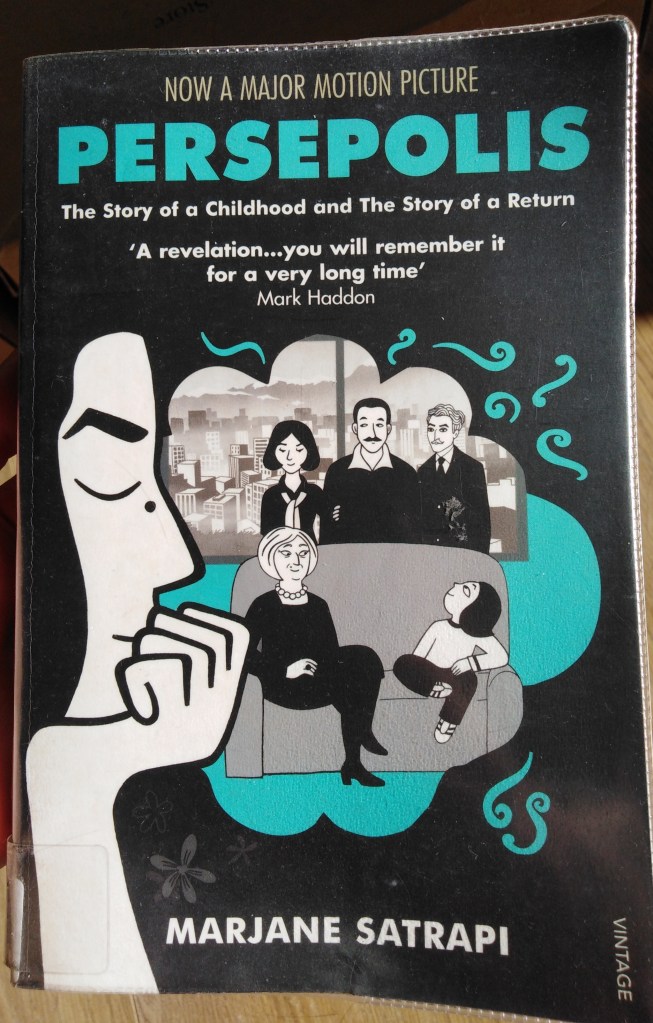
Book of the Month – Persepolis by Marjane Satrapi

Hello beautiful cats! How is everything with you? Here it’s all good and I feel like talking about books. The idea behind this blog, when I started it, was to talk about veganism, vegan food and books (as well as sharing my love for cats). So today I would like to start a “Book of the Month” feature. And the book for this month is “Persepolis” by Marjane Satrapi.

Persepolis – The Story of a Childhood and The Story of a Return

I might be a bit late on this, as I’ve recently learned that they made a motion picture of it, but it was quite a long time that I have been reading brilliant reviews of this book. And I finally know why. Satrapi actually wrote two books: “The Story of a Childhood” and “The Story of a Return”. Luckily, the version that the library has is the complete Persepolis, which includes both Satrapi’s books.

I opted for this because it’s a Young Adult book and the format is graphic novel: July has been an extra hectic month and I felt if I wanted to read, it needed to be something “light” as the mean, not the content, and a graphic novel would have been easier to read than another format.

The book is about the life of teenage Marjane in Iran during the change of regime at the end of the 1970s, her being sent by her parents for some time to Austria and her return to Iran in the 1990s.

It was enlightening because it gives a very different account of Iran than what we are used to hearing on the subject in the West. It might not be a comfortable read for some as it clearly states that the West has used many tactics over the years in order to appropriate Iran’s resources (i.e. oil). In the Introduction, we read:

"In the second millennium D.C., while the Elam nation was developing a civilization alongside Bbaylon, Indo-European invaders gave their name to the immense Iranian plateau where they settled. The word "Iran" was derived from "Ayryana Vaejo" which means "the origin o the Aryans." These people were semi-nomads whose descendants were the Medes and the Persians. The Medes founded the first Iranian nation in the seventh century B.C.: it was destroyed by Cyrus the GReat. He established what became one of the largest empires of the ancient world, the Persian Empire, in the sixth century B.C. Iran was referred to as Persia - its Greek name - until 1935 when Reza Shah, the father of the last Shah of Iran, asked everyone to call the country Iran.
Iran was rich. Because of its wealth and its geographic location, it invited attacks: from Alexander the Great, from its Arab neighbours to the west, from Turkish and Mongolian conquerors, Iran was often subject to foreign domination. Yet the Persian language and culture withstood these invasions. The invaders assimilated into this strong culture, and in some ways they became Iranians themselves.
In the nineteenth century, Iran entered a new phase. Reza Shah decided to modernize and westernize the country, but meanwhile a fresh source of wealth was discovered: oil. And with the oil came another invasion. The West, particularly Great Britain, wielded a strong influence on the Iranian economy. During the Second World War, the British, Soviets, and Americans asked Reza Shah to ally himself with them against Germany. But Reza Shah, who sympathized with the Germans, declared Iran a neutral zone. So the Allies invaded and occupied Iran. Reza Shah was sent into exile and was succeeded by his son, Mohammad Reza Pahlavi, who was known simply as the Shah.
In 1951, Mohammed Mossadeq, then prime minister of Iran, nationalized the oil industry. In retaliation, Great Britain organized an embargo on all exports of oil from Iran. In 1953, the CIA, with the help of British intelligence, organized a coup against him. Mossadeq was overthrown and the Shah, who had earlier escaped from the country, returned to power. The Shah stayed on the throne until 1979, when he fled Iran to escape the Islamic revolution.
Since then, this old and great civilization has been discussed mostly in connection to fundamentalism, fanaticism , and terrorism. As an Iranian who has lived more than half of my life in Iran, I know that this image is far from the truth. This is why writing Persepolis was so important to me. I believe that an entire nation should not be judged by the wrongdoings of a few extremists. I also don't want those Iranians who lost their lives in prison defending freedom, who died in the war against Iraq, who suffered under various repressive regimes, or who were forced to leave their families and flee their homelands to be forgotten.
One can forgive but one should never forget.
Marjane Satrapi
Paris, September 2002"

Thought-provoking

When reading this and all through the book, one might very probably see how it can resonate with what is happening now with the war in Ukraine. But also the wars in Syria, Afghanistan, Myanmar, Ethiopia, Yemen and all those countries that are affected by armed conflicts.

Persepolis is certainly a stimulating book that should be on the reading lists of every school.

Some extracts from the books

Satrapi’s father says “As long as there is oil in the Middle East we will never have peace” p.43

And again, her father says during a conversation with the author “This entire war was just a big setup to destroy both the Iranian and the Iraqi armies. The former was the most powerful in the Middle East in 1980, and the latter represented a real danger to Israel. The West sold weapons to both camps and we, we were stupid enough to enter into this cynical game… eight years of war for nothing. So now the State names streets after martyrs to flatter the families of the victims. In this way, perhaps, they’ll find some meaning in all this absurdity. ” p.255

Continuing on the topic, he also explains what happened before the armistice with Iraq: “One month before the armistice, Iraq began bombing Tehran every day, as if it were necessary to destroy as much as possible before it was over… The peace hadn’t yet been announced when the armed groups opposed to the Islamic Regime, the Iranian Mujahideen [the term Mujahideen isn’t specific to Afghanistan. It means a combatant.], entered the country from the Iraqi border with the support of Saddam Hussain to liberate Itan from the hands of its fundamentalist leaders. […] The Mujahideen thought that since it was the end of the war, our army wouldn’t have the strength to fight anymore. So, the Mujahideen also knew that the majority of Iranians were against the Regime, and they were therefore counting on popular support. But there was one thing that wasn’t in their calculations: they entered from Iraq. The same Iraq that had attacked us and against whom we had been fighting for eight years. With the result that, when they arrived in Iran, no one welcomed them. For the most part, they were killed by the Guardians of the Revolution and the army. But the Regime got scared because if these opponents had reached Tehran, they would have freed those who represented a real threat to the government that is to say the political prisoners who were the legitimate heirs of the Revolution and who constituted our Country’s intelligentsia so that the State decided to eliminate the problem. The following choice to the detainees: either they could renounce their revolutionary ideas, and promise fidelity and loyalty to the Islamic Republic, in which case they were done serving their time, or they would be executed, And, well, most of them were executed.” pp. 256-258

As Marjane started attending the College of Art in Iran, she come in touch with the reality of living in her home country and when thinking about the condition of the woman in the Regime she considered: “The Regime had understood that one person leaving her house while asking herself: ‘Are my trousers long enough?’, ‘Is my veil in place?’, ‘Can my make-up be seen?’, ‘Are they going to whip me?’ no longer asks herself: ‘Where is my freedom of thought?’, ‘My life, is it livable?’, ‘Where is my freedom of speech?’, ‘What’s going on in the political prisons?’. It’s only natural! When we’re afraid, we lose all sense of analysis and reflection. Our fear paralyzes us. Besides, fear has always been the driving force behind all dictators’ repression. Showing your hair or putting on makeup logically became acts of rebellion.” p.304

Regarding the war in Kuwait, there is a conversation between Marjane and her parents. Marjane’s mother: “Since when have you trusted our media? Their objective consists of making anti-Western propaganda.” Marjane: “Don’t let it get to you, mom! The Western media also fights against us. That’s where our reputation as fundamentalists and terrorists comes from!”. Marjane’s mother: “You’re right. Between one’s fanaticism and the other’s disdain, it’s hard to know which side to choose. Personally, I hate Saddam and I have no sympathy for the Kuwaitis, but I hate just as much the cynicism of the allies who call themselves ‘liberators’ while they’re here for the oil.” Marjane’s father: “Exactly. Just look at Afghanistan! They fought there for ten years. There were 900,000 dead and today the country is still in chaos. No one lifted a finger! Because Afghanistan is poor! The worst is that the intervention in Kuwait is done in the name of human rights!” p.324

Conclusion

As a kid in Europe, I’ve always heard of all the contemporary wars that have taken place (and are taking place) in the Middle East: all the various conflicts for all the different reasons. The reasons that are given by the West. Hence, this is a great read to get another perspective, another point of view on these conflicts with which we think we are familiar.

It’s been a very interesting read: it might not be the typical “beach read”, but it is well worth reading!

If you plan on reading it, or you’ve read it, let me know what you think about it.

Love,

TVCL xx

Reading and my love for it

I have been very lucky that since I was a child my parents have instilled the love for books and reading. My dad was already retired when I was born so he played an important role in raising me and I still remember him reading books on physics (and specialistic magazines on astronomy as well as computing). My mom was the one working every day and commuting and she loves reading and writing. Her commutes were a great time for her to get some time for herself and to read. Thanks to her work, one of the bonuses was that`1 she would get money in vouchers to spend in certain places, one of these was a bookstore in the city where she was working. It was always an exciting time when she was getting this voucher because she started taking me with her to buy the books for her and me. Oh! The books, the smell of that bookstore, paper and glue, the quiet buzz of people going there to buy stories but also to be in a serene environment away from the craziness of the city centre. I always enjoyed these visits and my mom never put limits on what we could buy (in terms of genre) and I think that’s a very positive way of educating kids as when you start imposing limits you’ll see that things like a taboo and eventually you might lose interest. Also, my little girl’s mind wasn’t going to be limited to “girly” books and if I were to choose an adventure or horror book, my mom would let me take it.

Now. You might think “But you are a librarian! You shouldn’t buy books, but you should go to the library!” I feel you, I really do and I wouldn’t agree with going to bookstores just for the sake of it, especially after my studies in Librarianship and having been working in a library for 4 years, I know that bringing kids to a library, making them understand the whole concept of borrowing things and then returning them. But these are peculiar situations: my mom was working till late and there was a small library in the village where we used to live with such reduced opening times that it was impossible for my mom to take me there; plus, the money was from the company my mom used to work for. So it’s almost a situation of “taking from the rich to give to the poor” kind of thing XD

On a Sunday we would all be reading something and it was such a relaxing time providing a break from the weekly madness of school visiting relatives and trying not to be bullied by schoolmates and the same relatives.

Reading has always been a pleasure. Except for those times when at school they forced us to read some authors or some books that I found utterly obnoxious – the authors – or extremely depressing – the books -: that was when teachers wanted people to read only those books that were deemed respectable enough: no comic books, manga, no Dork Diaries etc.

At the beginning of the school year, I would have been the second one to have read more books during the summer: no need to force me into reading. I would prefer the company of those fictional characters or learning about different species of animals to play with the other children. And that would also apply to holidays: every time we were going on holiday, whether for a few days or weeks, I had to bring with e AT LEAST ONE book: there would always be space for a book in my luggage. Probably now this is even more relevant because I tend to travel alone and having a book with me it means I am not really alone (not that I mind being by myself, but you know what I mean). It doesn’t matter where I go or for how long I am away, there has to be a book with me.

Benefits of Reading

Reading brings you to other words, it helps you develop more sensitivity and empathy when you read fiction, and it teaches you new things or strengthens your knowledge obviously, it might be that a book isn’t suitable for you (it happened that I couldn’t finish a book because it wasn’t for me or that I finished one but leaving me disappointed). This means that when you choose a book you’ll have to be careful because you’ll get into that world with those characters and you will be together for a bit. It is understandable when people tell me: “I don’t like to read, I look at the page and my mind goes blank” and I think that that’s because you haven’t found the right book. Yet. And with the book, I mean anything that is written because we are not all the same (otherwise the word would be pretty boring). Probably you have tried to read a fantasy while you actually would prefer romance, or you have been advised to read a history book when it is the latest anime that would make you happy. This is also part of the problem of the divide between readers and non-readers: some readers are too judgemental toward those who don’t read or what they read which makes the non-readers lose the will to read. We are all different and the main message here is we are all different: read, READ, read whatever catch your curiosity, whatever tickles your brain, because that will help you develop vocabulary, and grammar, it will help you relieve stress and more.

One of the books I read recently was the fifth book of “The Invisible Library” series which is not what you would expect. A beautiful fantasy with the main character a librarian but she’s a spy as well, if you want something fast-paced, with mysteries and intrigues, dragons and Faes and multi-worlds set in different periods in time, then this is for you. I always recommend it because Genevieve Cogman (the author) never fails to write a compelling story. Nice and easy read (might do a little review some time!).

To Conclude

Reading is one of the pleasures of life. Getting into other lives, other stories, learning new things. Don’t get discouraged by your past experiences and read all that you can.

Love,

TVCL xx

Reading Challenge

I got the idea for this challenge while talking with a friend: he was thinking of attending a literature course of 10 weeks, and part of it consisted of reading 5 books selected for said course, meaning that he would have had to read 5 books in 10 weeks. Now, the whole thing of reading something a list of books in a set time, reminded me way too much of school times when you had to read specific books during the summer holidays, so I had no real interest in the course my friend was talking about (too much of a free spirit here!). But I really liked the idea of having a set time to read some books: I love a nice challenge, and I love challenging myself in doing something (also kind of competitive, here).

A Bit Of Background

I have always been an avid reader, often preferring reading to go out playing with the other kids (having being bullied a lot as a kid, books were offering an oasis of peace and a break from the outer world). Long story short, the past two years I have been unable to read much (it took me 4 months to finish Middlemarch despite loving every page of it!) because I was focusing a lot on gaining a professional registration. And I really missed reading, diving deep into other worlds, other stories, learning new stuff thanks to non-fiction books, etc.

It is true that when one has spent after several hours focussing on work it is oh so easy to just collapse on the sofa or on the bed binge-watching all that TV has to offer. Same goes for the weekend because you need to recharge from the past week and at the same time you have to mentally prepare for the week ahead.

Hence this Challenge

If you, like me, are someone who likes to read but have been putting off that pile of books for a while, for a reason or for another – life happens -; or maybe you have been reading but not at your usual pace, so you want to go back to your rhythm; or perhaps you just want to start reading. Then this challenge is for you!

How It Works

The idea is to read 5 books in 10 weeks. “Which books?” you may ask. Well, that’s up to you, there are no restrictions on genres, on fiction or non-fiction, comic books, audiobooks: anything that inspires you, go for it!

All you need to do is to dedicate at least 30 minutes to reading, that’s all that this challenge is asking you. Any time during the day: being first thing in the morning during breakfast, or at lunchtime or in the evening. I personally feel that I can better commit to this challenge in the evening, after dinner: I usually watch something during my dinner (one episode of some show), then that’s it, I start to read. But I tell you, 30 minutes fly very quickly and I end up reading for the next 2-3 hours and being late for sleepy time!

There are so many benefits that you gain from reading: it ameliorates your vocabulary, helps to relieve stress, improve sleep and much more (you can read some more here and here)! Plus you learn stuff by reading non-fiction books (from biographies to science/history/philosophy/art/and so on books), you get into different worlds (from utopian to dystopian ones, from places in the outer space to fantastic worlds), but most importantly you’ll have a great time.

To Summarise

Choose your first book (physical, electronic, audiobook, comic, etc.), open it and start reading those first lines – letting yourself go into the world you chose for these first two weeks. Remember, the main purpose of this challenge is to enjoy yourself!

Let me know if you want to start the challenge, which book you chose as your first, or just if you’re thinking of starting it: I’ll be here if you need any help.

Talk to you soon!

Update on the Challenge

So, I started this challenge on the 25th of March, ending it the 27th of May. It has been great having a little push to read at the end of the day: as I said in the original post, a challenge of the sort would help you going back into your reading habits or even developing some new ones. Give it a try and let me know in the comments if you are taking part in it!

Following are the books I read:

  • Human Universe – Brian Cox Brilliant. loved it. Cox explains scientific stuff with ease and lightly so that even a person with little to no scientific knowledge (see, me) can follow and understand what he’s writing about;
  • 1984 – George Orwell. Creepingly beautiful. So on point with some of the ideals of that dystopia, it makes you think a lot about how the world. However, I would read it paired with Brave New World by Aldous Huxley because that is another dystopic worldview that again has some ideals quite close to what some people are advocating about. And once you have read the two, go and give a read to the letter Huxley sent Orwell after the latter sent 1984 to him: it is really an enjoyable short piece with such an interesting exchange of ideas between these two brilliant minds.
  • 21 Lessons for the 21st Century – Yuval Noah Harari. Another book that I really enjoyed. Harari deals with big themes like Religion and Immigration, then going into arguing what the values of the future could be. It
  • The Seven Deaths Of Evelyn Hardcastle – Stuart Turton. Loved it. There is not much to say: if you like parallel universes, time travel and lots of thrills and mysteries this is for you. Oh, and there are a couple of twists in there!
  • The Skeptics’ Guide to the Universe – Steven Novella et al. This one was difficult to read. I like critical thinking, I am quite the advocating for it, but I am unsure about this book.
  • The Priory Of The Orange Tree – Samantha Shannon. Absolutely brilliant. A good all-female fantasy

I also tried The Thousand Autumns of Jacob de Zoet by David Mitchell, but I couldn’t pass the first 10 pages. There is a very detailed description of the birthing of a dead foetus. No thanks. I am sorry I couldn’t go past it, and I didn’t want to chance reading about something like that again later on in the book.

I hope this will inspire you to read. And remember, even reading one book (remember, any format!) will be very beneficial to everything, from stress and anxiety release to improve your mental health.

Happy reading! 🙂

Reading Challenge

I got the idea for this challenge while talking with a friend: he was thinking of attending a literature course of 10 weeks, and part of it consisted of reading 5 books selected for said course, meaning that he would have had to read 5 books in 10 weeks. Now, the whole thing of reading something a list of books in a set time, reminded me way too much of school times when you had to read specific books during the summer holidays, so I had no real interest in the course my friend was talking about (too much of a free spirit here!). But I really liked the idea of having a set time to read some books: I love a nice challenge, and I love challenging myself in doing something (also kind of competitive, here).

A Bit Of Background

I have always been an avid reader, often preferring reading to go out playing with the other kids (having being bullied a lot as a kid, books were offering an oasis of peace and a break from the outer world). Long story short, the past two years I have been unable to read much (it took me 4 months to finish Middlemarch despite loving every page of it!) because I was focusing a lot on gaining a professional registration. And I really missed reading, diving deep into other worlds, other stories, learning new stuff thanks to non-fiction books, etc.

It is true that when one has spent after several hours focussing on work it is oh so easy to just collapse on the sofa or on the bed binge-watching all that TV has to offer. Same goes for the weekend because you need to recharge from the past week and at the same time you have to mentally prepare for the week ahead.

Hence this Challenge

If you, like me, are someone who likes to read but have been putting off that pile of books for a while, for a reason or for another – life happens -; or maybe you have been reading but not at your usual pace, so you want to go back to your rhythm; or perhaps you just want to start reading. Then this challenge is for you!

How It Works

The idea is to read 5 books in 10 weeks. “Which books?” you may ask. Well, that’s up to you, there are no restrictions on genres, on fiction or non-fiction, comic books, audiobooks: anything that inspires you, go for it!

All you need to do is to dedicate at least 30 minutes to reading, that’s all that this challenge is asking you. Any time during the day: being first thing in the morning during breakfast, or at lunchtime or in the evening. I personally feel that I can better commit to this challenge in the evening, after dinner: I usually watch something during my dinner (one episode of some show), then that’s it, I start to read. But I tell you, 30 minutes fly very quickly and I end up reading for the next 2-3 hours and being late for sleepy time!

There are so many benefits that you gain from reading: it ameliorates your vocabulary, helps to relieve stress, improve sleep and much more (you can read some more here and here)! Plus you learn stuff by reading non-fiction books (from biographies to science/history/philosophy/art/and so on books), you get into different worlds (from utopian to dystopian ones, from places in the outer space to fantastic worlds), but most importantly you’ll have a great time.

To Summarise

Choose your first book (physical, electronic, audiobook, comic, etc.), open it and start reading those first lines – letting yourself go into the world you chose for these first two weeks. Remember, the main purpose of this challenge is to enjoy yourself!

Let me know if you want to start the challenge, which book you chose as your first, or just if you’re thinking of starting it: I’ll be here if you need any help.

Talk to you soon!