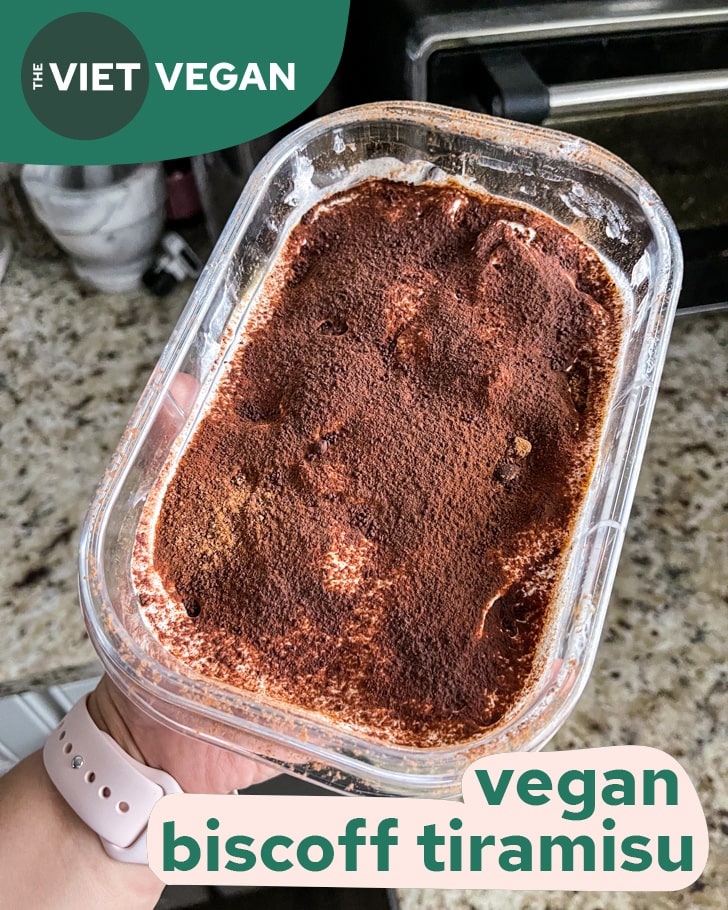
Hello, hello, beautiful cats! I hope you’re enjoying your weekend! A few days ago was my birthday and nothing scream “birthday” to me as tiramisu. It has been the dessert that my aunt used to make for all my birthdays and although my mom would make a delicious cake for my birthday parties, my auntie’s tiramisu has always been a favourite.
In a heat-safe bowl, combine instant coffee granules, sugar, and boiling water and stir to dissolve the sugar. Let come to room temperature. Take out the Cocowhip from the freezer and let sit out at room temperature to soften while the coffee mixture cools down.
Fully dip your Biscoff cookies, one cookie at a time, into the sweetened coffee mixture and layer in a flat and shallow container (I used a 3.2 cup Rubbermaid [affiliate link] container). Work quickly as the cookies start to disintegrate fairly quickly once soaked.
Then add a layer of Cocowhip on top of the soaked cookies, about 1/3 cup per layer.
You’ll be adding 3 layers of soaked Biscoff cookies, and 3 layers of cocowhip. I did 6 cookies per layer, with a thin layer of Cocowhip between each layer.
I like to add an extra thick layer of Cocowhip on top, then dust with a coating of cocoa powder to finish. I dust using a fine mesh sieve to create a light, even layer of cocoa powder.
Cover and let it set in the fridge for at least 30 minutes.
Hi beauties! I hope everything is well with you! For the second instalment of Book of the Month I wanted to share with you this book, which is a very easy read by author Lynne Truss (not to be confused with the new UK Prime Minister, and ex Shell employee, Liz Truss) – Cat out of Hell.
This is not the first book I’ve read by Lynne Truss: I started with Eats, Shoots and Leaves: The Zero Tolerance Approach to Punctuation (a book for grammar-Nazi, and I mean it with all the love as I feel very close to them) and I also read the sequel of Cat out of Hell, which is The Lunar Cats.
What’s in the book?
Clearly, I was drawn up to this book because of the title: it has “cat” in it and that was already a great selling point! And having read Eats, Shoots and Leaves I knew the writing would have not disappointed me.
It is also a short book, and the version that was readily available from the library was in large print, which made it even an easier read (not ashamed of taking a large print book and I encourage you to try them!).
The main characters are a librarian and two “evil cats”: the story follows some deaths connected to sightings of such felines and the librarian is going to solve these mysteries. Love me a story involving a smart detective librarian!
Truss has a very specific sense of humour that you can see in most of her books: it’s dry and very British, so it might not be for everybody. But it’s surely my favourite!
As for the genre, it’s a delicious mix of fantasy and mystery. If you like the idea of a fantasy/mystery book with the main character a detective librarian, there is also the series The Invisible Library by Genevieve Cogman (and will definitely feature AT LEAST one book of the series here).
Some Quotes
“Since Mary died, I have looked at people bothering about ridiculous things and I simply cannot bear it! How can they be ignorant of the fact that – in a second – we are gone? Any sort of cruelty or stupidity dismays me.” (p.75)
“The smell – well. WE’d noticed the smell, of course, but we didn’t realise it was coming from here. Some of the readers – well, you know what they’re like.” (p.82)
“I was so startled that I giggled. This man can’t have satanic eyeballs, I thought. He’s a librarian.” (p.170)
Conclusion
This is a very easy read and very funny and the writing is impeccable. The plot is perfect, especially for those who love libraries, librarians and cats. A great read for any time of the year, from a cosy Sunday afternoon with a blanket and cup of tea, or for the beach.
Whether you’ve read it or plan to, let me know your thoughts.
Happy Sunday, beautiful kittens! We’re getting into Autumn, time to start taking the cosy clothes out of the closet and preparing for some time on with a hot beverage. And while I know that these Potatoes Arrabbiata by the Jewish Vegetarian Society are meant more for Spring (for Pesach, Passover which is in April), I feel that they are very good for Autumn too (as well as Winter!).
I saw this recipe not that long ago and made it just a few days ago: look how inviting it is! And obviously, so easy to make it’s beginner’s proof. So, without further ado, the recipe.
Ingredients
Handful of baby potatoes (skin on)
1 garlic clove, sliced
Pinch of dried chili flakes
200g passata
Handful of spinach
Olive oil
Salt and pepper
Method
Cook the potatoes in a pan of salted boiling water for about 10 minutes, until cooked through. Drain.
Pan-fry the sliced garlic in a splash of olive oil over a medium heat for a few minutes until it starts to brown, then add the chili flakes, passata and cooked potatoes.
Season generously with salt and pepper and simmer for about 10 minutes.
Add the spinach and simmer for a further minute until wilted, then squash each potato with the back of a fork, remove from the heat and serve.
Enjoy!
Let me know if you knew this recipe already or if you made it.
Hello kittens, how are you today? Here all good, just enjoying the weekend and sharing another scrumptious recipe with you: the Delicious Vegan Mushroom Stroganoff by VeganPunks. I was kind of craving mushrooms, but wanted to make something different from a mushroom risotto or a veggie stir-fry, I looked into the recipes that I bookmarked and this stroganoff was among the ones that I could make with the ingredients that I had.
The last time I had a mushroom stroganoff was at a pub and I shared it with a friend. Oooft, it wasn’t that good: the sauce was almost acrid, the accompanying rice seemed microwaved and overall it wasn’t an enjoyable experience. So, when I’ve seen this recipe in my bookmarks I decided that it would be good to try.
Melt the butter in a saucepan over a medium heat and fry the onion until soft
Add the garlic and cook for 1 minute then chuck the mushrooms in and cook until they release a little water and have reduced in size – roughly 5 minutes.
Sprinkle the paprika over the ingredients and stir well and pour the stock into the saucepan, bringing to a boil, then quickly reduce to a simmer.
Next spoon in the crème fraîche and stir well, whilst watching it melt into the sauce.
Pop in the Worcestershire sauce.
When the sauce is still simmering, add the cornflour mix.
Simmer for 15-20 minutes until the sauce cooks down a bit and you’re left with a rich, creamy sauce, the consistency of thin cream.
Season with salt and pepper (to taste), top with fresh chopped parsley and serve with rice or mashed potato.
I had it with arborio rice, but I believe basmati or jasmine rice would be delicious too.
Hello cuties, how is everything with you? Here we can feel the transition from summer to autumn and I love it! Especially today, it was sunny and the air was cold and crisp: perfect! And this brings me to this post which I am dedicating to September.
September is a special month for me. It actually has always been a special time of the year and I was thinking about this one day while meditating after a short yoga session.
When I was a child, while September had the nostalgic taste of the end of summer (where I would be spending a lot of time with my parents) with returning to school (with all the relative issues of having to deal with bullies, etc.), it also had the excitement of there being 4 birthdays in this month: my dad’s, mine, my mom’s and my grandad’s. Plus it was the month of my parents’ wedding anniversary. I mean, basically a whole month of celebrations, what’s not to like? We would celebrate each individual birthday, spending it together. The, from when I was 8 years old for the next 10 years, my mom, dad and me, we used to go for a short city break to a European country. It all started when I was turning 8, going to the main train station nearby and picking the next train going abroad: my parents would book a last minute ticket for the three of us and we would spend the next 3 to 5 days away and we would eat one traditional dessert of the place we visited. The first city was Paris.
September is also the month I left home to move to a different country. At the end of the summer 2015 I decided that I needed to change my life and on the 3rd of September I left home with just a backpack. It has been one of the best decisions I ever made: I had many different experiences, learned a lot and grew up (especially mentally and spiritually). I am a place that I love, doing a job that makes me feel great about myself and proud of what I do. I feel a much closer connection to the community I live in. I believe I am experiencing happiness as well as a calm that I rarely experienced before. Obviously, I think sometimes of what my life would be now if I never left home and I would see more of my parents, which is something I miss. But with every decision you’ll always have pros and cons, so I take it this way.
The other great event that happened in September, was I got my current job. I studied to get the degree that would have enabled me to get a job in libraries and worked my way up, from library assistant to librarian. Thanks to other decisions that I had to make and then led to this job, which I truly love and am passionate about.
And another positive thing, I finally moved to a lovely flat, clean, with a garden and allowed pets (and three months later I adopted my cat!).
So, here it is why September is the most special month for me.
Hello kittens and Happy Sunday to you! After a month, I finally managed to get back into some kind of routine and yesterday was my first Saturday off in 4 weeks, so I slept (a lot!), did the laundry as it was sunny and windy perfect for hanging everything outside and went in town to get some fresh ginger root. As soon as I videocalled my parents, my mom said she saw me very relaxed, so I believe the day off was really needed! I just wanted to share this recipe with you as I made it two days ago while I was preparing dinner: 5 ingredients, 3 steps and 1 great result!
This is one of the recipes that you can find in the “Speedy Broke Vegan” book by Saskia Sidey: I didn’t know anything about the author, and it was my partner who brought the book from the library where he works. All the recipes are easy to make, demand little effort and the majority of the ingredients can be found at your grocery store (even in little rural towns!). If you can find the book at your local library, borrow it because I’m sure you’ll find something that you can make very easily. Hence, these Porridge Oat Bars.
Ingredients
75g (3 oz) oats;
150ml (1/4 pint) plant-based milk of your choice;
1 banana;
1 tbsp sweetener of your choice, i.e. maple syrup, brown sugar, etc.
1 tsp baking powder
Method
Preheat the oven to 180° (350° F).
Blend all the ingredients together until smooth.
Pour batter into a small ovenproof dish (16×12 cm, 6 1/2×5 in). Bake until golden and firm (15-20 minutes).
That’s it!
In the book, you’ll find also some variants of this dessert, such as the Black Berry Forest, Carrot Cake and Peanut Butter&Jelly.
Hello my cats! How is your Sunday going? This has been the third Saturday I was working and … Today’s recipe is something that is really delicious: a vegan omelette made not only with chickpea flour but also with tofu, a Spanish Omelette. My mouth is watering just at the thought! The recipe I usually follow is the Vegan Tortilla-Spanish Omelette by ForkfulOfPlants. Obviously, easy and quick!
Add the sliced potatoes to a saucepan, cover with boiling water and simmer for 10 minutes, draining and rinsing with cold water once cooked.
Meanwhile, make the batter mixture. Add the chickpea flour, silken tofu, water, black salt, turmeric, nutritional yeast, garlic powder and a grind of black pepper to a blender or food processor, and blend until smooth.
Heat a tablespoon of olive oil in a 20-25cm non stick frying pan frying pan over a medium heat.
Add the sliced onion and fry it for 3-4 minutes until lightly browned and softened. Add the cooked and drained sliced potatoes to the pan. Stir the potatoes and onions to mix, then arrange the potatoes in a flat layer.
Pour the batter over the potatoes and onions in an even layer. Reduce the heat to medium-low and cook for 8-10 minutes, until the top has no runny liquid left sitting on it (it will still be soft).
When the first side is cooked, it’s time to flip the omelette! Take a large, flat plate, and place it upside down on top of the pan.
With your hand on top of the plate, flip the pan upside down, moving the tortilla onto the plate. Then, carefully slide the tortilla back into the pan on the uncooked side.
Cook for 3-4 minutes on the second side, then slide the cooked vegan omelette on to a clean plate to serve.
Happy Sunday, kittens! I hope you’re having a nice weekend. Here it has been very hot for a few days, with a very clear sky and temperatures around 27°C which is exceptionally high for where I live! Today I decided to go to the shops to get a little present for a colleague: the shop I wanted to visit is not in the town centre and I can reach it in 15 minutes by walking, so I went to the shop, got the present and when I went out it started raining. I got literally soaked! Wasn’t expecting that. Oh well, that’s life. Anyway, enough of my adventure! Because it is so warm, I wanted to share the recipe for a dessert that doesn’t need too much heat to prepare and is still extremely delicious: Vegan Chocolate Covered Strawberries by Nutriciously!
I made them quite recently and are already on my list of favourite recipes. In addition, if you omit the white chocolate these are also a great snack or dessert for when you do the Limpia.
Ingredients
1 lb fresh strawberries (450 g)
Vegan chocolate coating
1 cup semi-sweet dark chocolate, chopped (100 g)
1 tsp almond butter (optional)
½ cup vegan white chocolate, chopped (50 g)
Toppings
Instructions
Prepare the strawberries
Rinse and drain the strawberries without removing the green leaves.
Pat dry with paper towels and place them in the fridge.
Make the chocolate coating
Get two clean bowls and put the chopped dark chocolate in one, the chopped white chocolate in the other.
Fill two pots ¼ of the way with water and bring to a boil. Reduce to low heat, then place the bowls inside — make sure they are big enough to cover the pots!
Let the chocolate melt over the sightly boiling water, stirring occasionally.
When the dark chocolate has melted, add the almond butter and stir to incorporate.
Dip & coat your strawberries
Remove the strawberries from the refrigerator and get a tray lined with parchment paper.
Gather your toppings: melted dark chocolate, melted white chocolate, crushed almonds, shredded coconut and cocoa nibs. Make sure each of them gets its own little bowl or plate.
Grasp your first strawberry by the small green leaves and dip it into the melted dark chocolate, aiming to coat the strawberry evenly. Shake off any excess, then put your coated strawberry on your prepared tray. Repeat with the remaining strawberries and place them in a single layer on your tray. Drizzle a few of them with more black or contrasting white chocolate by using a fork or a piping bag.
Finally, add some crunchy toppings! Roll your chocolate-covered strawberries in the prepared bowls with crushed almonds, shredded coconut or cocoa nibs.
Refrigerate the decorated strawberries for 30 minutes before serving.
Easy-peasy! I hope you’ll enjoy these snacks perfect for the summer.
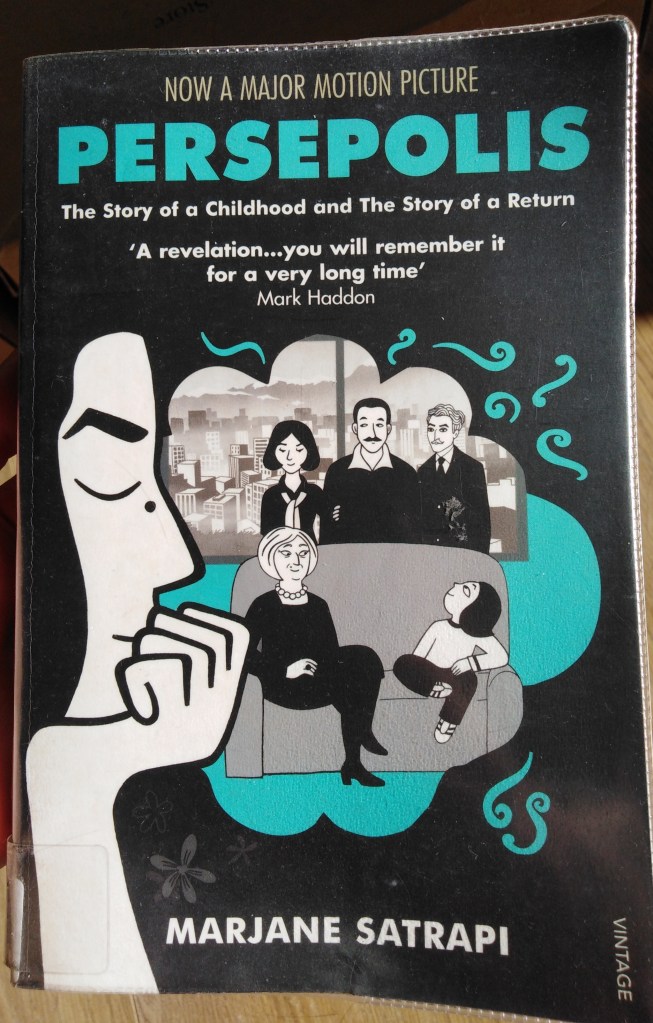
Hello beautiful cats! How is everything with you? Here it’s all good and I feel like talking about books. The idea behind this blog, when I started it, was to talk about veganism, vegan food and books (as well as sharing my love for cats). So today I would like to start a “Book of the Month” feature. And the book for this month is “Persepolis” by Marjane Satrapi.
Persepolis – The Story of a Childhood and The Story of a Return
I might be a bit late on this, as I’ve recently learned that they made a motion picture of it, but it was quite a long time that I have been reading brilliant reviews of this book. And I finally know why. Satrapi actually wrote two books: “The Story of a Childhood” and “The Story of a Return”. Luckily, the version that the library has is the complete Persepolis, which includes both Satrapi’s books.
I opted for this because it’s a Young Adult book and the format is graphic novel: July has been an extra hectic month and I felt if I wanted to read, it needed to be something “light” as the mean, not the content, and a graphic novel would have been easier to read than another format.
The book is about the life of teenage Marjane in Iran during the change of regime at the end of the 1970s, her being sent by her parents for some time to Austria and her return to Iran in the 1990s.
It was enlightening because it gives a very different account of Iran than what we are used to hearing on the subject in the West. It might not be a comfortable read for some as it clearly states that the West has used many tactics over the years in order to appropriate Iran’s resources (i.e. oil). In the Introduction, we read:
"In the second millennium D.C., while the Elam nation was developing a civilization alongside Bbaylon, Indo-European invaders gave their name to the immense Iranian plateau where they settled. The word "Iran" was derived from "Ayryana Vaejo" which means "the origin o the Aryans." These people were semi-nomads whose descendants were the Medes and the Persians. The Medes founded the first Iranian nation in the seventh century B.C.: it was destroyed by Cyrus the GReat. He established what became one of the largest empires of the ancient world, the Persian Empire, in the sixth century B.C. Iran was referred to as Persia - its Greek name - until 1935 when Reza Shah, the father of the last Shah of Iran, asked everyone to call the country Iran.
Iran was rich. Because of its wealth and its geographic location, it invited attacks: from Alexander the Great, from its Arab neighbours to the west, from Turkish and Mongolian conquerors, Iran was often subject to foreign domination. Yet the Persian language and culture withstood these invasions. The invaders assimilated into this strong culture, and in some ways they became Iranians themselves.
In the nineteenth century, Iran entered a new phase. Reza Shah decided to modernize and westernize the country, but meanwhile a fresh source of wealth was discovered: oil. And with the oil came another invasion. The West, particularly Great Britain, wielded a strong influence on the Iranian economy. During the Second World War, the British, Soviets, and Americans asked Reza Shah to ally himself with them against Germany. But Reza Shah, who sympathized with the Germans, declared Iran a neutral zone. So the Allies invaded and occupied Iran. Reza Shah was sent into exile and was succeeded by his son, Mohammad Reza Pahlavi, who was known simply as the Shah.
In 1951, Mohammed Mossadeq, then prime minister of Iran, nationalized the oil industry. In retaliation, Great Britain organized an embargo on all exports of oil from Iran. In 1953, the CIA, with the help of British intelligence, organized a coup against him. Mossadeq was overthrown and the Shah, who had earlier escaped from the country, returned to power. The Shah stayed on the throne until 1979, when he fled Iran to escape the Islamic revolution.
Since then, this old and great civilization has been discussed mostly in connection to fundamentalism, fanaticism , and terrorism. As an Iranian who has lived more than half of my life in Iran, I know that this image is far from the truth. This is why writing Persepolis was so important to me. I believe that an entire nation should not be judged by the wrongdoings of a few extremists. I also don't want those Iranians who lost their lives in prison defending freedom, who died in the war against Iraq, who suffered under various repressive regimes, or who were forced to leave their families and flee their homelands to be forgotten.
One can forgive but one should never forget.
Marjane Satrapi
Paris, September 2002"
Thought-provoking
When reading this and all through the book, one might very probably see how it can resonate with what is happening now with the war in Ukraine. But also the wars in Syria, Afghanistan, Myanmar, Ethiopia, Yemen and all those countries that are affected by armed conflicts.
Persepolis is certainly a stimulating book that should be on the reading lists of every school.
Some extracts from the books
Satrapi’s father says “As long as there is oil in the Middle East we will never have peace” p.43
And again, her father says during a conversation with the author “This entire war was just a big setup to destroy both the Iranian and the Iraqi armies. The former was the most powerful in the Middle East in 1980, and the latter represented a real danger to Israel. The West sold weapons to both camps and we, we were stupid enough to enter into this cynical game… eight years of war for nothing. So now the State names streets after martyrs to flatter the families of the victims. In this way, perhaps, they’ll find some meaning in all this absurdity. ” p.255
Continuing on the topic, he also explains what happened before the armistice with Iraq: “One month before the armistice, Iraq began bombing Tehran every day, as if it were necessary to destroy as much as possible before it was over… The peace hadn’t yet been announced when the armed groups opposed to the Islamic Regime, the Iranian Mujahideen [the term Mujahideen isn’t specific to Afghanistan. It means a combatant.], entered the country from the Iraqi border with the support of Saddam Hussain to liberate Itan from the hands of its fundamentalist leaders. […] The Mujahideen thought that since it was the end of the war, our army wouldn’t have the strength to fight anymore. So, the Mujahideen also knew that the majority of Iranians were against the Regime, and they were therefore counting on popular support. But there was one thing that wasn’t in their calculations: they entered from Iraq. The same Iraq that had attacked us and against whom we had been fighting for eight years. With the result that, when they arrived in Iran, no one welcomed them. For the most part, they were killed by the Guardians of the Revolution and the army. But the Regime got scared because if these opponents had reached Tehran, they would have freed those who represented a real threat to the government that is to say the political prisoners who were the legitimate heirs of the Revolution and who constituted our Country’s intelligentsia so that the State decided to eliminate the problem. The following choice to the detainees: either they could renounce their revolutionary ideas, and promise fidelity and loyalty to the Islamic Republic, in which case they were done serving their time, or they would be executed, And, well, most of them were executed.” pp. 256-258
As Marjane started attending the College of Art in Iran, she come in touch with the reality of living in her home country and when thinking about the condition of the woman in the Regime she considered: “The Regime had understood that one person leaving her house while asking herself: ‘Are my trousers long enough?’, ‘Is my veil in place?’, ‘Can my make-up be seen?’, ‘Are they going to whip me?’ no longer asks herself: ‘Where is my freedom of thought?’, ‘My life, is it livable?’, ‘Where is my freedom of speech?’, ‘What’s going on in the political prisons?’. It’s only natural! When we’re afraid, we lose all sense of analysis and reflection. Our fear paralyzes us. Besides, fear has always been the driving force behind all dictators’ repression. Showing your hair or putting on makeup logically became acts of rebellion.” p.304
Regarding the war in Kuwait, there is a conversation between Marjane and her parents. Marjane’s mother: “Since when have you trusted our media? Their objective consists of making anti-Western propaganda.” Marjane: “Don’t let it get to you, mom! The Western media also fights against us. That’s where our reputation as fundamentalists and terrorists comes from!”. Marjane’s mother: “You’re right. Between one’s fanaticism and the other’s disdain, it’s hard to know which side to choose. Personally, I hate Saddam and I have no sympathy for the Kuwaitis, but I hate just as much the cynicism of the allies who call themselves ‘liberators’ while they’re here for the oil.” Marjane’s father: “Exactly. Just look at Afghanistan! They fought there for ten years. There were 900,000 dead and today the country is still in chaos. No one lifted a finger! Because Afghanistan is poor! The worst is that the intervention in Kuwait is done in the name of human rights!” p.324
Conclusion
As a kid in Europe, I’ve always heard of all the contemporary wars that have taken place (and are taking place) in the Middle East: all the various conflicts for all the different reasons. The reasons that are given by the West. Hence, this is a great read to get another perspective, another point of view on these conflicts with which we think we are familiar.
It’s been a very interesting read: it might not be the typical “beach read”, but it is well worth reading!
If you plan on reading it, or you’ve read it, let me know what you think about it.
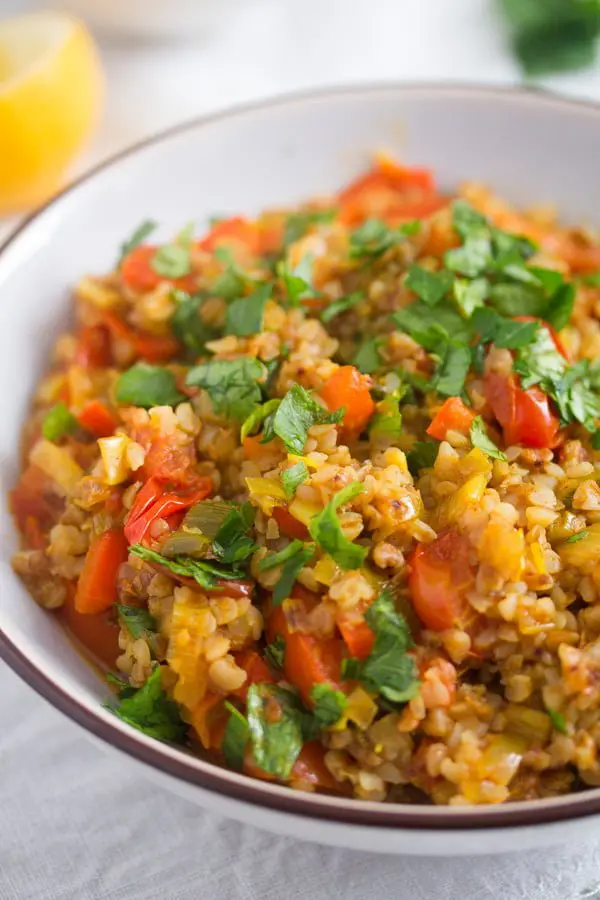
Hello beautiful kittens! Here the weather has been quite benevolent, not too hot (only a couple of days with unusually high temperatures two weeks ago, whew!) so I’ve been able to cook and bake and all – love it! One of the recipes I tried is this Roasted Buckwheat with Vegetables by WhereIsMySpoon: probably the third recipe I made with buckwheat and it’s lovely. Obviously nice and easy and quick.
As buckwheat is not a cereal but a seed similarly to quinoa and amaranth, it can be used in recipes that also would call for a cereal, making for the perfect gluten-free lunch/dinner (and limpia-friendly too!).
200 g/ 7 oz/ about 1 cup buckwheat groats Notes 1 and 2
350 ml/ 11.8 fl. oz/ 1 ¾ cups vegetable broth
2 tablespoons olive oil
2 medium onions about 150 g/ 5.3 oz
2 garlic cloves
2 bell peppers
1 leek about 120 g/ 4.2 oz (Note 3)
15 cherry tomatoes
½ teaspoon smoked paprika powder
1 teaspoon sweet paprika powder
½ teaspoon turmeric
¼ – ½ teaspoon hot chili flakes to taste
juice from 1 lemon
250 ml/ 8.4 fl.oz/ 1 cup vegetable broth
salt and black pepper
Instructions
Chop the onions finely, the garlic as well, cut the peppers into thin strips, halve the leeks lengthwise, if very thick, and cut the halves into thin half rounds.
Bring the vegetable stock used for cooking the buckwheat groats to a boil. When the liquid boils, add the rinsed buckwheat groats, cover the saucepan with a lid and simmer on low heat until done to your liking.
Heat the oil in a larger and deeper pan. Cook the onions for about 2 minutes. Add the garlic, peppers, and leeks. Stir well and cook for about 3-4 minutes or until slightly softer.
In the meantime, halve the cherry tomatoes. Add them to the pan with smoked and sweet paprika powder, turmeric, chili flakes, lemon juice, and vegetable broth.
Cover, turn the heat down to medium-low, and cook the vegetables, occasionally stirring, for about 10 minutes or until done to your liking.
Add the cooked kasha to the vegetable pan and stir well but carefully.
Adjust the taste generously with sea salt, freshly ground black pepper, and the remaining lemon juice.
The recipe calls for a carrot and yojurt sauce, but I haven’t tried it with that and it was already spectacular.





 The Vegan Cat Librarian