Happy Sunday my beauties! Is everything okay with you? This weekend has been so lovely, I have enjoyed a couple of nice autumn walks and also a trip to a local Christmas Market and coming back from these walks I was craving some comfort food. This Creamy Potato Leek Soup by SimpleVeganista was definitely the answer to these cravings!
1 tablespoon olive oil or 1/4 cup water (for water saute)
3 medium leeks(use white and light green parts only)
2 1/2 lbs. potatoes, cubed 1/2 inch (peeled or with skin on)
1 1/2 teaspoons dried thyme or Herbes de provence
1 bay leaf
4 cups water or low-sodium vegetable broth
mineral salt, to taste
1/4 cup chopped parsley, to garnish
Method
Start by removing and discarding the root ends of the leeks and thick dark green parts.
Cut the leeks in half lengthwise and rinse each half under cold water, pulling apart the layers to remove any sand or debris nestled inside, slice the leeks crosswise. Alternatively, slice the leeks, then put in a colander and wash well under running water. Should yield 4 – 5 cups.
Cut the potatoes into 1/2 inch cubes. Feel free to peel the potatoes or leave the skin on (I left the skin on).
In a large dutch oven or pot, heat the oil/water over medium heat. Add the leeks and cook, stirring frequently, until soft and wilted, about 10 minutes. Adjust the heat as necessary so as not to brown the leeks.
Add the potatoes, broth, bay leaves, herbs, salt to the pot and bring to a boil. Reduce heat, cover, and simmer on low for 15 minutes, or until the potatoes are fork-tender.
Remove the bay leaves, and puree the soup using a hand-held immersion blender until smooth (or leave a little chunky). Alternatively, use a regular blender to puree the soup in batches. Taste for seasoning.
Alternatively
If you don’t want to use potatoes, you can use 3 carrots instead of the potatoes. I’ve tried also adding half a broccoli and it’s DE-LI-CIOUS!
I hope you’ll try both ways and let me know what you think.
Hey there! How is it in your neck of the woods? Here all good, just avoiding burnout by taking it a bit easier at work and meditating more.
You might have noticed in the past months a petition started by Cruelty-Free International asking for the closure of Vivotecnia, “an independent European toxicology contract research organisation based in Madrid, Spain. Since 2000, it has offered services to support pharmaceutical and biotech, cosmetic, chemical and agrochemical industries. Its customers include companies from Spain, Europe (including the UK), Central America, Japan, Korea and the USA.”
These are just two of the petitions asking for governments to ban vivisection (especially for beauty products). It would appear that more and more people realise that experimenting on live animals is just barbaric, considering that there is so much research confirming the uselessness of these practices.
To be honest, I have only a little bit of hope that these petitions will be successful because the experiments are usually required by the main pharmaceutical and beauty multinationals. And this brings me to the Huntingdon issue in the UK.
Huntingdon and MBR Acres Ltd.
Maybe you have heard or maybe not, that during the years people have been protesting what is happening at the MBR Acres Ltd facilities in Huntingdon, Cambridgeshire, England (just to give you an idea, one of the latest protests was this May). But if you don’t have a clear idea of what I am talking about, here are some facts about Huntingdon (Huntingdon Life Sciences Group plc.):
it’s a contract research organisation, privately owned
founded in 1951
had an initial focus on focused on nutrition, veterinary, and biochemical research
their research uses animals, both wildlife imported from other countries and “local”
it went on researching pharmaceuticals, food additives, industrial and consumer chemicals
in 1996, a member of PETA went undercover as an employee of the organisation and recorded the treatment of the animals in Huntingdon’s facilities
the tape sparked rage amongst animal rights activists and PETA was sued by HLS. HLS managed to win.
the buildings in Huntingdon have been the subject of numerous protests by animal activists.
I shouldn’t be stating the obvious, but any form of experimentation on animals is just wrong. It wouldn’t be justifiable even if what they are testing was the cure for cancer. And they are not experimenting on that. In the 2000s they stated that they were very close to a breakthrough in xenotransplants, organ transplants from animal to human. Pigs and primates were the main subjects of these experiments: the non-human animals were grown to then harvest their organs and then put them in humans. The longest a human has survived after such a transplant is three months. THREE MONTHS.
The suffering that this practice brings is twofold: it causes much pain to the animals that are grown for the sole purpose of taking their organs and the people into which these organs are implanted.
What is vivisection
Depending on the dictionary one uses, one will get a slightly different definition of what this practice is. From Merriam-Webster, vivisection is
: the cutting of or operation on a living animal usually for physiological or pathological investigation broadly: animal experimentation especially if considered to cause distress to the subjectMerriam-Webster Dictionary
While Cambridge Dictionary offers that vivisection is
the use of living animals in tests that are intended to increase human knowledge of human diseases and the effects of using particular drugs.Cambridge Dictionary
Contradictions of vivisection
The main contradiction is that the promoters of such practice will say that they use such and such animal species because they will get similar reactions as if it were human, but when they’ll be asked if they’re concerned about the feelings and emotions and pain that these species will have to endure, the vivisectors will say that although similar in bodies to humans, they really don’t feel the same as them.
Without even going into the philosophical aspects of the ethics behind this practice, the mind is part of the body: pain receptors ARE pain receptors, which means that they are telling the brain that that thing is painful and the non-human or human animal is feeling pain.
All animals, humans and non-humans, when they are enclosed in small spaces, hearing screams or seeing their fellows being taken away and then taken back wounded and hurt, are going to feel fear, being afraid.
So, if someone is telling you that live non-human animals are good for testing because of their similarities with humans, but not to worry because they don’t feel the same as humans do, call BS on them.
The Alternatives
There are alternatives to animal testing. It’s 2022, we went to the moon and around space. We keep finding ever smaller particles. We do have ways to avoid the use of animals in research: from cell culture to computer simulation, there really are viable alternatives. Companies who don’t use non-human animals in their testing are known as cruelty-free.
If you want to read a bit more about the alternatives to animal testing, you can find some more here and here (2 Wikipedia pages, to get you started).
Conclusion
Huntingdon Life Sciences and MBR Acres are just two of the many organisations around the world that are using live animals to test on. If you think that animal testing is wrong, there are quite a lot of websites that are providing you with lists of brands that conduct this kind of testing, as well as those that are in the process of becoming cruelty-free. Keeping on testing on animals, with money spent on this instead of investing in alternatives just extends the suffering of both human and nonhuman animals.
Beautiful kittens! How is life treating you these days? It’s nearly Halloween, can you believe it?! I just thought of sharing this recipe very quickly with you, because I feel we need a lot of comfort with all that is happening around the world. And what best comfort food if not PASTA?! And there is the recipe for a vegan ricotta within the main recipe! What’s not to like? So, without further ado, here are the Vegan Stuffed Shells Florentine by ConnoisseurusVeg.
6 ounces dried jumbo pasta shells (about 20 shells)
For the Quick Tomato Sauce
1 tablespoon olive oil
½ large onion, diced
3 garlic cloves, minced
1 (28 ounce or 794 gram) can crushed tomatoes
½ tablespoon organic granulated sugar
1 teaspoon dried oregano
½ teaspoon salt, plus more to taste
¼ teaspoon black pepper, plus more to taste
½ cup fresh basil leaves, torn and lightly packed
For the Vegan Ricotta Florentine
½ cup roughly chopped onion (about ½ of a medium onion)
3 garlic cloves, minced
1 cup raw cashews soaked in water 4-8 hours, rinsed and drained
½ cup unflavored and unsweetened soy or almond milk
2 tablespoons lemon juice
1 (14 ounce or 400 gram) package extra firm tofu, drained and broken into 5-6 large chunks
½ teaspoon salt, plus more to taste
¼ teaspoon black pepper, plus more to taste
2 cups fresh spinach leaves, coarsely chopped and lightly packed
Method
Bring a large pot of salted water to a boil. Add the pasta shells and cook them according to the package directions.
Drain the pasta into a colander, then return it to the pot and toss it with a few dashes of olive oil. Set aside.
Make the Quick Tomato Sauce
Coat the bottom of a medium saucepan with oil and place it over medium heat. Once the oil is hot, add the onion. Sweat the onion until softened, about 5 minutes.
Add the garlic and sauté it with the onion 1 minute more, until very fragrant.
Stir in the crushed tomatoes, sugar, oregano, salt and pepper. Bring the mixture to a simmer and lower the heat.
Allow the sauce to simmer, uncovered, for 15 minutes, stirring occasionally.
Stir in the basil and remove the sauce from the heat. Taste test and season with additional salt and pepper if desired.
Make the Vegan Ricotta Florentine
Place the onion, garlic, cashews, milk and lemon juice into bowl of food processor. Blend until smooth, stopping to scrape down sides of bowl as needed.
Add the tofu, salt and pepper. Pulse the machine until a thick and slightly chunky, ricotta-like texture is achieved, again, stopping to scrape down the sides of bowl as needed.
If some space remains in food processor bowl, add the spinach and pulse until finely chopped and well blended. Otherwise, transfer mixture to a bowl and stir the spinach in by hand.
Taste-test and season the mixture with additional salt and pepper to taste.
Make the Stuffed Shells Florentine
Preheat the oven to 400º. Coat the bottom of a 9 inch by 9 inch baking dish or 10 inch round oven-safe skillet with about half of sauce.
Stuff the shells with the ricotta mixture and arrange them in a single layer in the baking dish or skillet. Top with the remaining sauce.
Cover and bake the shells for 20-25 minutes, until the sauce is bubbly.
Remove the shells from the oven and allow them to sit for 5 minutes before serving.
Hello cuties! How is everything with yous? I hope you’re having a brilliant weekend, spending it doing what makes you feel good. If you’re not, and you have to deal with unpleasant things, I really hope you’ll get over this soon. In any way, I feel that the recipe I’m sharing with you today will bring a smile to your face.
Pear muffins are something I wouldn’t have thought I would have loved this much because I’ve never been a fan of pears. But at some point, I found myself with so many pears and wasn’t sure about what I could do with them: a browse online for “quick vegan pear recipes” and there it was, Comforting Wholesome Pear Muffins by SeitanIsMyMotor! Tried it, absolutely loved it and you will too!
6 mini pears or six pear quarters (or ½ cup diced pear)
Instructions
Preheat oven to 200°C and grease 6 muffin tins with oil.
In a bowl, combine flour, sugar, baking powder, and baking soda and mix well.
Stir in remaining ingredients except for pears.
Pour the batter into the muffin tins and press pears into the batter. Or, if you are using diced pears, mix them into the batter before pouring the muffins into the tins.
Happy Sunday, beauties! The past three weeks have been busy, had to work two Saturdays in a row and also helped cover for other members of staff during the week, and I’ve been getting at the end of the week just drained, no matter all the “keeping hydrated + exercising + sleeping 7 hours per night + eating healthy”. But Saturday night means also cabbage soup! Comforting and warm, full of healthy veggies, it’s the perfect dish for the end of a long week.
This is my favourite Vegan Cabbage Soup by LovingItVegan. The recipe calls for Cayenne pepper: I don’t really use it, but obviously, if that’s your taste go for it! Same goes for the broth/stock: the end result is already flavourful so you can skip this (perfect if you have to keep an eye on your salt intake too!). Also, I like to switch the beans I put in the soup: any white beans are great, but also Borlotti and Red Kidney work well in this recipe.
Happy Sunday, dearest! We’re getting into Autumn, my second favourite season, with the leaves turning from green to yellow and orange and all the different tones of these colours, the air becoming less and less hot perfect for snuggling under a blanket on the sofa with a warm mega-mug of tea. Yes, I love Autumn. And with this season we can finally bake and make all that food that heats up your kitchen. So I feel that today is a good time to share this recipe for vegan sufganiyot that I found ages ago, tried and loved it. It’s unclear why I haven’t shared this with you earlier!
I found the recipe by chance, don’t even remember how the search went, but I’m glad I found Mayim Bialik’s recipe for Vegan Sufganiyot because it’s easy to make and oh my goodness! So. Delicious. I didn’t know about sufganiyot (and various other spellings): they are basically Jewish doughnuts made usually for Hannukah. And for those of you who don’t know her, Mayim Bialik used to play Amy in The Big Bang Theory and she also acts and is the executive producer of the sitcom Call Me Kat. On top of this, she has a PhD in neuroscience! And she’s vegan. Really difficult not to like her!
So, here is this delicious recipe!
Ingredients
0.25-oz. envelope active dry yeast
1/2 cup sugar
1 cup plus 2 Tbsp. warm (about 110°F) soy, rice, or almond milk
3 1/2 cups all-purpose flour, plus more for dusting
1 1/4 tsp. coarse salt
Egg replacer equivalent of 2 eggs
3 tbsp. unsalted vegan margarine, melted and cooled
Nonstick cooking spray
6 cups vegetable oil, for frying
Icing sugar, for sprinkling
About 2 cups raspberry jam (optional)
Method
1. Combine the yeast, sugar, and 1 cup of the warm nondairy milk in a small bowl and let stand until foamy, about 8 minutes.
2. Whisk together the flour and salt in a bowl. Add the yeast mixture, egg replacer, and margarine, and beat until the dough is soft but not sticky, about 3 minutes.
3. On a lightly floured surface, knead the dough until smooth and elastic, 3 to 4 minutes. Transfer the dough to a medium bowl coated with nonstick cooking spray, and cover loosely with plastic wrap. Let rise in a warm, draft-free place until doubled in size, about 1 1/2 hours.
4. Punch down the dough. On a lightly floured surface, knead the dough a few times, and roll out to 1/4-inch thick. Cover with a clean dish towel, and let rest for 5 minutes.
5. Using a 2-inch-diameter cookie cutter, cut out rounds and transfer to a lightly floured baking sheet. Re-roll the scraps, and cut out the remaining dough. Cover the rounds with a clean dish towel and let rise in a warm, draft-free place for 20 minutes.
6. Meanwhile, heat the oil in a large, heavy-bottomed pot until it reaches 375°F.
7. Place a wire rack on top of parchment paper or on a baking sheet, and line with paper towels or brown paper bags. Working in batches of four or five, add the doughnuts to the hot oil and fry, turning once, until golden and puffed, about 1 minute per side. Using a slotted spoon, place the doughnuts on the paper towels to cool.
8. Sprinkle with icing sugar. You can also make some jam-filled doughnuts, by spooning jam into a pastry bag fitted with a plain 3/8-inch tip. Pierce a hole in the side of a doughnut with the tip, and squeeze in jam to fill (the filled doughnut will feel heavy). Note: Be sure to drain well before serving and enjoy!
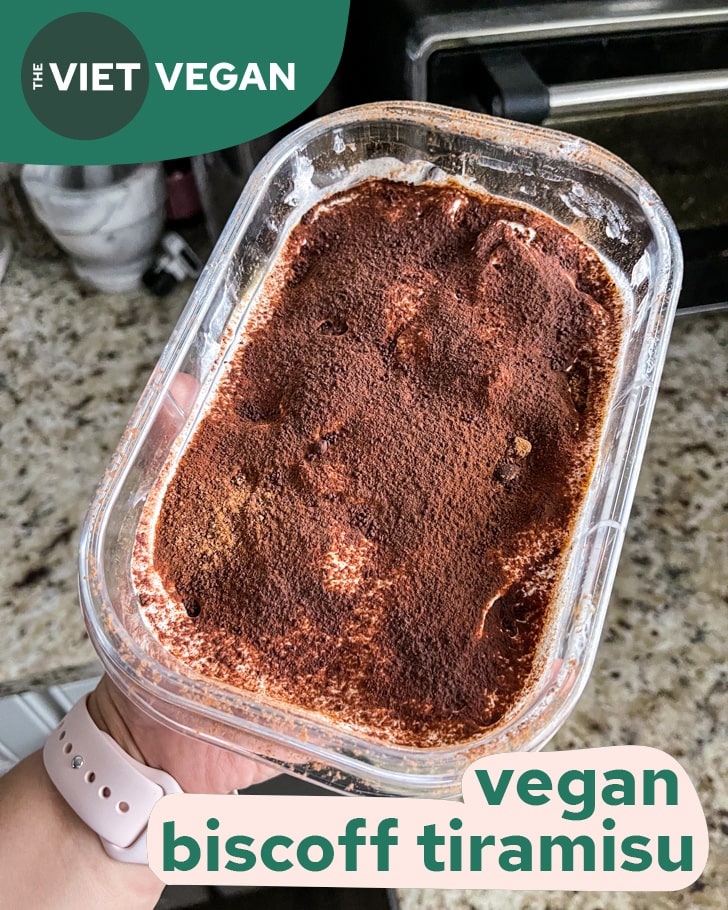
Hello, hello, beautiful cats! I hope you’re enjoying your weekend! A few days ago was my birthday and nothing scream “birthday” to me as tiramisu. It has been the dessert that my aunt used to make for all my birthdays and although my mom would make a delicious cake for my birthday parties, my auntie’s tiramisu has always been a favourite.
In a heat-safe bowl, combine instant coffee granules, sugar, and boiling water and stir to dissolve the sugar. Let come to room temperature. Take out the Cocowhip from the freezer and let sit out at room temperature to soften while the coffee mixture cools down.
Fully dip your Biscoff cookies, one cookie at a time, into the sweetened coffee mixture and layer in a flat and shallow container (I used a 3.2 cup Rubbermaid [affiliate link] container). Work quickly as the cookies start to disintegrate fairly quickly once soaked.
Then add a layer of Cocowhip on top of the soaked cookies, about 1/3 cup per layer.
You’ll be adding 3 layers of soaked Biscoff cookies, and 3 layers of cocowhip. I did 6 cookies per layer, with a thin layer of Cocowhip between each layer.
I like to add an extra thick layer of Cocowhip on top, then dust with a coating of cocoa powder to finish. I dust using a fine mesh sieve to create a light, even layer of cocoa powder.
Cover and let it set in the fridge for at least 30 minutes.
Happy Sunday, beautiful kittens! We’re getting into Autumn, time to start taking the cosy clothes out of the closet and preparing for some time on with a hot beverage. And while I know that these Potatoes Arrabbiata by the Jewish Vegetarian Society are meant more for Spring (for Pesach, Passover which is in April), I feel that they are very good for Autumn too (as well as Winter!).
I saw this recipe not that long ago and made it just a few days ago: look how inviting it is! And obviously, so easy to make it’s beginner’s proof. So, without further ado, the recipe.
Ingredients
Handful of baby potatoes (skin on)
1 garlic clove, sliced
Pinch of dried chili flakes
200g passata
Handful of spinach
Olive oil
Salt and pepper
Method
Cook the potatoes in a pan of salted boiling water for about 10 minutes, until cooked through. Drain.
Pan-fry the sliced garlic in a splash of olive oil over a medium heat for a few minutes until it starts to brown, then add the chili flakes, passata and cooked potatoes.
Season generously with salt and pepper and simmer for about 10 minutes.
Add the spinach and simmer for a further minute until wilted, then squash each potato with the back of a fork, remove from the heat and serve.
Enjoy!
Let me know if you knew this recipe already or if you made it.
Hello kittens, how are you today? Here all good, just enjoying the weekend and sharing another scrumptious recipe with you: the Delicious Vegan Mushroom Stroganoff by VeganPunks. I was kind of craving mushrooms, but wanted to make something different from a mushroom risotto or a veggie stir-fry, I looked into the recipes that I bookmarked and this stroganoff was among the ones that I could make with the ingredients that I had.
The last time I had a mushroom stroganoff was at a pub and I shared it with a friend. Oooft, it wasn’t that good: the sauce was almost acrid, the accompanying rice seemed microwaved and overall it wasn’t an enjoyable experience. So, when I’ve seen this recipe in my bookmarks I decided that it would be good to try.
Melt the butter in a saucepan over a medium heat and fry the onion until soft
Add the garlic and cook for 1 minute then chuck the mushrooms in and cook until they release a little water and have reduced in size – roughly 5 minutes.
Sprinkle the paprika over the ingredients and stir well and pour the stock into the saucepan, bringing to a boil, then quickly reduce to a simmer.
Next spoon in the crème fraîche and stir well, whilst watching it melt into the sauce.
Pop in the Worcestershire sauce.
When the sauce is still simmering, add the cornflour mix.
Simmer for 15-20 minutes until the sauce cooks down a bit and you’re left with a rich, creamy sauce, the consistency of thin cream.
Season with salt and pepper (to taste), top with fresh chopped parsley and serve with rice or mashed potato.
I had it with arborio rice, but I believe basmati or jasmine rice would be delicious too.
Hello my cats! How is your Sunday going? This has been the third Saturday I was working and … Today’s recipe is something that is really delicious: a vegan omelette made not only with chickpea flour but also with tofu, a Spanish Omelette. My mouth is watering just at the thought! The recipe I usually follow is the Vegan Tortilla-Spanish Omelette by ForkfulOfPlants. Obviously, easy and quick!
Add the sliced potatoes to a saucepan, cover with boiling water and simmer for 10 minutes, draining and rinsing with cold water once cooked.
Meanwhile, make the batter mixture. Add the chickpea flour, silken tofu, water, black salt, turmeric, nutritional yeast, garlic powder and a grind of black pepper to a blender or food processor, and blend until smooth.
Heat a tablespoon of olive oil in a 20-25cm non stick frying pan frying pan over a medium heat.
Add the sliced onion and fry it for 3-4 minutes until lightly browned and softened. Add the cooked and drained sliced potatoes to the pan. Stir the potatoes and onions to mix, then arrange the potatoes in a flat layer.
Pour the batter over the potatoes and onions in an even layer. Reduce the heat to medium-low and cook for 8-10 minutes, until the top has no runny liquid left sitting on it (it will still be soft).
When the first side is cooked, it’s time to flip the omelette! Take a large, flat plate, and place it upside down on top of the pan.
With your hand on top of the plate, flip the pan upside down, moving the tortilla onto the plate. Then, carefully slide the tortilla back into the pan on the uncooked side.
Cook for 3-4 minutes on the second side, then slide the cooked vegan omelette on to a clean plate to serve.






 The Vegan Cat Librarian